Cappadocia in Winter: Snow, Balloon Cancellations & Is It Worth It?
Affiliate disclosure: this article contains affiliate links to tour and experience marketplaces such as Viator and GetYourGuide. If you book through them, Vooygo may earn a commission at no extra cost to you. Nothing here is sponsored, no operator paid to be named, and the widget appears where it does because the activity fits the section — not because of payout. Where we could not verify a figure, we say so instead of estimating.
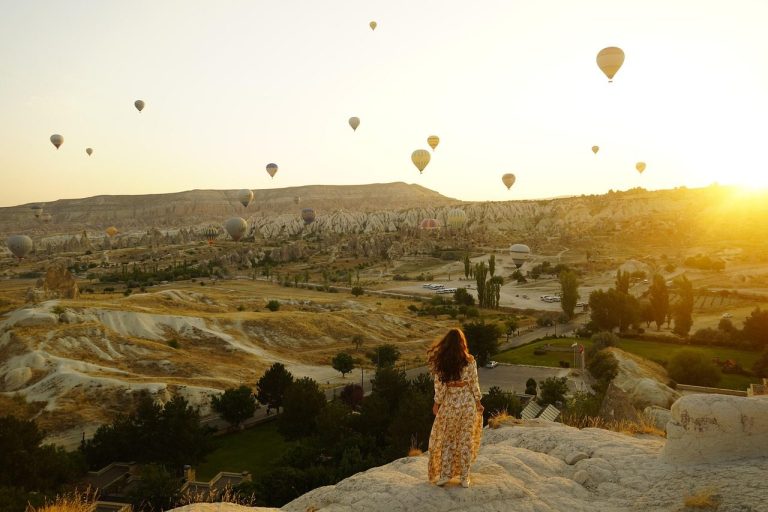
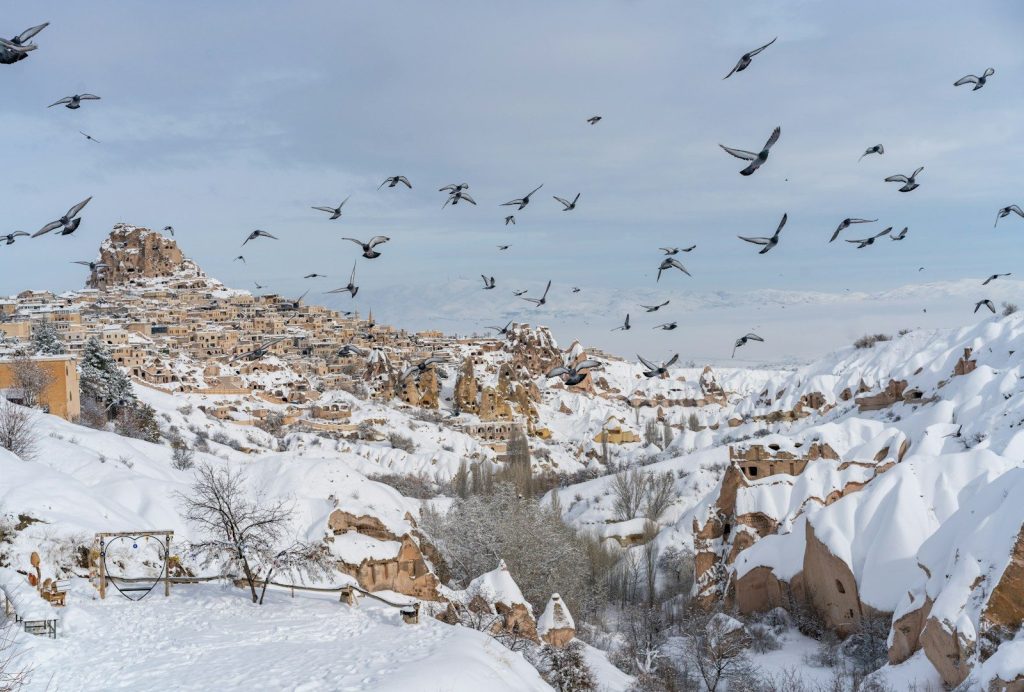
Cappadocia in winter is the same landscape as the postcard, minus the crowd and plus the snow, and the trade you make is not simply “cold instead of warm”. What you are actually trading is predictability. From April to October the balloon question barely exists: you book a morning, you fly. Between December and February the same booking becomes a weather-dependent bet with a decision point before dawn, and the valley you photograph in a good year is an entirely different place from the one in the brochures — chimneys under snow, tracks through the white, almost nobody at the viewpoints at sunrise.
So this guide answers the three questions that winter trips actually hinge on. First, what the season is really like, month by month, with numbers rather than adjectives. Second, how real your odds of flying are, and what happens when the flight is cancelled — the mechanics, the refund-versus-rebook choice, and the arithmetic of booking more than one morning. Third, whether the trip is still worth it, including the parts of Cappadocia that run perfectly well when the balloons do not.
Everything below is written for a traveller who is deciding, not browsing. If you want the operational side — which operator, which basket, private versus group — that lives on our Cappadocia hot air balloon tours guide instead, and the month-by-month pricing lives on the balloon price by month page. This page stays on the season.
How to read the numbers here: climate normals come from the published Nevşehir and Kayseri weather records (retrieved 2 October 2026); sunrise and sunset times are computed for Göreme’s coordinates (38.64° N, 34.83° E) at Turkey’s fixed UTC+3, so they do not shift with daylight saving; the flight-approval mechanics come from the published Turkish rules summary and an operator-side flight-day explainer, both cited in full at the point of use. Where a number simply does not exist in public — winter cancellation rates are the big one — we say that plainly rather than inventing one.
What Winter Looks Like in Cappadocia
Winter in Cappadocia is not one continuous scene. It is three different weeks that repeat in different orders: clear, hard, blue-sky cold with frost in the shaded valley floors; snow events that dump a layer on the chimneys and then sit there for days because the air stays below freezing; and grey, windy, marginal mornings where nothing settles but the balloons cannot fly either. A ten-day trip will usually contain all three.
The single most useful thing to understand is the elevation. Göreme sits at roughly 1,100 m, Ürgüp and Nevşehir a little lower, Uçhisar and the higher viewpoints above that, and the plateau behind them stretches to 1,200–1,500 m. That height is why Cappadocia is several degrees colder than Istanbul on the same day, why snow settles here when the coast gets rain, and why the temperature you see for “Cappadocia” on a phone can be off by a couple of degrees depending on which village is being measured. Nevşehir’s January records show a typical daily high of 4.1 °C and a low of −3.5 °C; Kayseri, an hour east and slightly higher, runs about half a degree cooler on the high and nearly two degrees colder at night.
What changes with the season, concretely:
- The valleys stay open. The main walking routes — Love Valley, Rose Valley, Pigeon Valley, the Göreme loop — are not closed in winter. Snow on the paths is the real constraint, plus ice in the shaded sections, and the trails get shorter in practice because daylight is short.
- The viewpoints get better, and emptier. Sunset Point above Göreme and the Uçhisar castle approach are packed in summer and nearly deserted in January. Snow on the ridges reads as texture in photographs rather than blown-out white, which is why winter is when a lot of the good Cappadocia photography is actually made.
- Cave hotels stay open; some services thin out. Winter is low season, so a minority of small properties close for maintenance and a few restaurants cut their hours. Bigger cave hotels in Göreme, Ürgüp and Uçhisar run year-round, and the ones built into the rock hold warmth well.
- Balloons fly or they do not, and the reason is almost never the snow. This is the most misunderstood part of a winter trip, and it has its own section below: the go/no-go call is about wind and visibility, not about how pretty the valley looks.
Cappadocia in December
December is the month the season arrives rather than the month it peaks. Early December can still look like a late-autumn trip — bare vines, cold mornings, the valleys walkable in a jacket — and then a snow event somewhere in the second half changes the register completely. The days are still losing length: on 15 December the sun rises around 07:51 and sets around 17:20, which is only about nine and a half hours of usable light.
Weather normals for December (Nevşehir / Kayseri, retrieved 2 October 2026):
| Measure | Nevşehir | Kayseri |
|---|---|---|
| Typical daily high | 6.2 °C | 6.5 °C |
| Typical daily mean | 2.0 °C | 0.8 °C |
| Typical night low | −1.4 °C | −3.6 °C |
| Precipitation | 48.4 mm | 39.3 mm |
| Days with precipitation | 11.8 | 11.2 |
| Sunshine | 85.4 hours | 83.7 hours |
Two readings matter here. First, December is the wettest of the three winter months on these records, and because the mean sits within a degree or two of freezing, a good share of that precipitation arrives as snow on the plateau — which is exactly why a white Cappadocia at Christmas is a realistic hope rather than a lottery win. Second, the sunshine figure is low: only about 85 hours across the month, roughly a third of what July delivers. That is the grey, marginal weather that makes balloon mornings uncertain.
Crowds: December is where the season empties out. The first three weeks are genuinely quiet — hotel availability is wide, restaurants take walk-ins, and the Göreme Open Air Museum car park is not a competitive sport. The last ten days flip: Turkish families travel over New Year, domestic bookings spike, and cave-hotel rates for 30–31 December reset to something closer to summer. If your plan is “quiet valleys”, aim for 5–20 December. If your plan is “snow and a cave hotel with a fireplace for New Year”, book that window early.
Practical note for December specifically: this is the month when you should build a spare morning into the itinerary, because it has both the shortest daylight and the highest chance of a marginal flight day. Two mornings booked beats one morning booked, and the reasoning is arithmetic rather than superstition — see Your Realistic Odds of Flying below.
Cappadocia in January
January is the deep winter month: the coldest means, the sharpest night frost, and — counter-intuitively — often the clearest skies of the season. Sunshine hours actually rise from December to January in the Nevşehir records (85.4 to 95.7 hours), because the storm track weakens and the plateau settles into dry, still, high-pressure cold. Those stable mornings are exactly the ones the balloons want, which is why January is not automatically the worst month to fly despite being the coldest to stand around in.
What that feels like: a typical January high around 4.1 °C in Nevşehir, a mean at freezing, and nights down to −3.5 °C — and lower in the hollows and higher in Kayseri, whose January night normals sit near −5.4 °C. Add wind and the perceived temperature drops well below the number on the screen, which is why the packing section below is not boilerplate.
| What to expect in January | Detail |
|---|---|
| Coldest month of the three | Nevşehir mean 0.0 °C; January is the low point of the year |
| Night frost | Near-certain; untreated side streets stay icy in the morning |
| Snow | Regular, and slow to disappear — snow cover often holds for several days |
| Sky | The clearest of the winter months on the published sunshine figures |
| Crowds | The quietest month; the valleys are effectively yours |
For travellers, January has two real advantages and one real cost. The advantages: empty valleys and the lowest room rates of the year, and the cleanest light for photography, because dry cold air carries less haze than the damp air of December. The cost: it is the month you least want to be standing in an open field at dawn, and the balloon decision is made before dawn. The workaround is not heroic — book a hotel inside Göreme or Ürgüp so the pick-up is short, wear the layers described below, and treat the balloon morning as a separate decision from the rest of the day.
One more January-specific thing worth knowing: snow that falls in January tends to stay, so a traveller arriving mid-month is more likely to get the full white postcard than one arriving in early December. That cuts both ways — a settled snowpack is beautiful, and it also means the shaded valley paths can be genuinely slippery, so footwear is a safety item in January rather than a comfort item.
Cappadocia in February
February is the pivot month. It is still winter — the mean is barely above freezing in Nevşehir and the night normals stay negative — but the days lengthen noticeably, the cold loses its edge, and by the second half of the month you can feel the shoulder season coming. On 15 February the Göreme sun is up from about 07:32 to 18:18, near enough an hour more usable light than a month earlier, and the sunshine total jumps to around 118 hours on the Nevşehir records.
That extra light changes what a day can hold. A February itinerary fits two valley walks rather than one, a full underground city visit, and a sunset viewpoint without rushing — whereas the same plan in December has to be cut. It also slightly improves the average case for flying, because more of the morning window falls inside daylight and the wind pattern is beginning to ease from its January peak: the operator-side explainer we cite in the next section describes Cappadocia as flying year-round but windiest in January and February, so February’s length is bought partly at the cost of continued wind risk.
| February measure | Nevşehir | Kayseri |
|---|---|---|
| Typical daily high | 6.0 °C | 6.6 °C |
| Typical night low | −2.6 °C | −4.5 °C |
| Precipitation | 41.8 mm | 38.9 mm |
| Sunshine | 118.4 hours | 113.0 hours |
| Crowds | Low, rising in the last week |
Crowds in February are still low, with one caveat: the last week of the month is when European half-term travel and early shoulder-season bookings begin, so the very cheapest and quietest version of February is the first three weeks.
Weather by Month, in One Table
This is the table that most Cappadocia winter weather guides do not have: snow and crowds in the same grid as temperature, rain and wind. Most of them give you a temperature line and leave you to guess the two things you are actually deciding on — whether it will look like winter, and whether you will have the place to yourself.
| December | January | February | |
|---|---|---|---|
| Typical high / low (Nevşehir) | 6.2 °C / −1.4 °C | 4.1 °C / −3.5 °C | 6.0 °C / −2.6 °C |
| Mean temperature | 2.0 °C | 0.0 °C | 1.3 °C |
| Precipitation | 48.4 mm (wettest) | 43.7 mm | 41.8 mm |
| Days with precipitation | 11.8 | 12.1 | 11.7 |
| Sunshine hours | 85.4 (greyest) | 95.7 | 118.4 (brightest) |
| Snow: does it settle? | Yes — second half of the month is the reliable window | Yes, and cover usually holds for days | Yes, still frequent early; slushy late |
| Snow character | Arrives in events; early December may be bare | Deepest and most persistent snowpack | Wet, heavier, faster to melt |
| Wind character | Marginal mornings; fronts passing through | Peak wind month of the year | Still windy, easing late |
| Daylight (Göreme, mid-month) | 07:51–17:20 (9h29m) | 07:57–17:43 (9h46m) | 07:32–18:18 (10h46m) |
| Crowds | Low until ~20 Dec, then holiday spike | Quietest month of the year | Low, rising in the final week |
| Balloon-morning quality | Uncertain: grey, wet, short | Good when the high settles; wind is the risk | Improving, still wind-limited |
| Best for | Christmas and New Year atmosphere | Empty valleys and photography | Combining winter scenery with longer days |
Read the table as a decision tool rather than a ranking. If the snow scene is the point of the trip, January and the second half of December are the strongest bets. If you want the snow plus a workable sightseeing day, February gives you an extra hour of light for a modest step up in crowds. If you want the cheapest possible version of Cappadocia and do not mind grey mornings, the first half of January is the quietest and least expensive window of the year.
Two honest caveats. First, these are climatological normals, not a forecast — a specific week can run ten degrees off the mean in either direction, and a February trip can be colder than a December one. Check the ten-day forecast in the final week before you travel; for the wider seasonal picture across the country, our month-by-month guide to the best time to visit Turkey puts all four seasons side by side. Second, we deliberately give no snow-depth figure, because published monthly snow-depth series for the Göreme basin are not available at the resolution that would make the number meaningful; the honest statement is “snow settles in most winters and usually holds for several days”, not “there will be 20 cm on 14 January”.
Why Balloons Get Cancelled in Winter
Here is the part that surprises people: in Cappadocia, rain does not cancel balloon flights. Wind does. Snow on the ground is irrelevant to the flight itself. The go/no-go decision is about the movement of air at and above the launch field, and that decision is not made by your hotel or your operator.
All hot-air balloon operations in the region are regulated by SHGM, the Directorate General of Civil Aviation of Turkey, and flights operate under a daily approval system — every morning’s flying is authorised, or not, on the day, based on aviation-grade weather data rather than how the sky looks from a terrace. The published rules summary lists the triggers plainly: flights are cancelled when wind speed exceeds the safe limit, when wind direction is unstable, when visibility is insufficient, or when sudden weather changes are detected. Two consequences follow directly from that list. Cancellations happen even on sunny mornings and even in high season, and they can happen on a morning after a morning that flew perfectly (source: Official Hot Air Balloon Flight Rules in Cappadocia, published 24 December 2025, retrieved 2 October 2026).
The numbers behind the wind rule, from the operator side: the go/no-go call is made at the launch field about an hour before lift-off, and surface wind over roughly 10 knots grounds the fleet (source: flight-day explainer at hotairballoondays.com, retrieved 2 October 2026). Ten knots is a moderate breeze — enough to move loose snow across a field, not enough to feel alarming standing still. That mismatch is the whole reason winter mornings go wrong for unprepared travellers: it does not look like a day that should be called off.
What this means practically, in winter specifically:
- Temperature is not the limiting factor. Balloons fly in the cold; the burners produce far more heat than the envelope loses. A −10 °C morning is flyable if the air is still.
- Wind is higher in winter. The same explainer describes Cappadocia as flying year-round but windiest in January and February. That is the single best argument for booking more than one morning in those months.
- Fog and low visibility are a winter-specific risk that does not exist in summer: radiation fog forms in the valley floors on still, clear, cold nights, and it can sit below the launch altitude or over the landing zones.
- Instability matters more than the average. A steady ten-knot wind and a gusting, direction-shifting ten-knot wind are different problems, and the second one is what winter fronts deliver. The approval system looks at both.
- The decision comes early and it is final. Because the call is made an hour before lift-off, the message arrives while it is still dark, typically before your alarm would have gone off for a normal day. Have a plan for what you do with the morning instead.
A note on rain and snow that does matter: heavy snow can affect the road to the launch site and the landing fields, and snow on the roads is a transport problem rather than a flight problem. In practice, road conditions around Göreme and Ürgüp are managed quickly and rarely close for long, but a morning after a heavy fall is the one time both the flight and the pick-up are genuinely in question.
For the operational side — which operators run which baskets, and what a private flight costs you in comfort versus a shared one — the details are on our Cappadocia balloon tour comparison; the point here is only that no operator can promise you a flight, whatever their marketing says, because the approval is not theirs to give.
Your Realistic Odds of Flying
Now the honest part, and the part no competing guide attempts: nobody publishes Cappadocia’s winter cancellation rate. We looked. Operators advertise cancellation policies, not frequencies, and no authority publishes a per-month grounding percentage. So rather than quote a number we cannot source, we are giving you the arithmetic — the structure of the bet — so you can plug in whatever figure you trust and see what it does to your trip.
Three facts shape the arithmetic. Each morning is one slot: the launch window is around sunrise, once per day, so a three-night stay gives you a maximum of three chances. The outcomes are roughly independent across mornings — a front that grounds Monday usually passes rather than persisting identically through Tuesday, though multi-day windy spells do happen in January. And the decision is made for you and outside your control, which is exactly why the number of mornings you book is the only lever you actually hold.
Here is what different grounding rates do to the chance of a blank trip — every morning you booked, grounded — if you book one, two, three or four mornings. The arithmetic is nothing more than the grounding rate raised to the number of mornings, so you can check any cell yourself:
| If a single morning is grounded… | 1 morning | 2 mornings | 3 mornings | 4 mornings |
|---|---|---|---|---|
| 1 morning in 4 (friendliest) | 1 in 4 | 1 in 16 | 1 in 64 | 1 in 256 |
| 1 morning in 3 | 1 in 3 | 1 in 9 | 1 in 27 | 1 in 81 |
| 1 morning in 2 (harshest) | 1 in 2 | 1 in 4 | 1 in 8 | 1 in 16 |
Read it the other way round and it is your chance of flying at least once: under the friendliest assumption, one morning gets you airborne three times in four, two mornings fifteen times in sixteen, three mornings sixty-three times in sixty-four, and a fourth morning buys you the last slice — two hundred and fifty-five times in two hundred and fifty-six.
The pattern is the useful part, and it holds at every rate: the jump from one morning to two is enormous, and the jump from three to four is small. Under the friendliest assumption a second morning cuts the chance of a blank trip from one in four to one in sixteen, while a fourth morning only moves it from one in sixty-four to one in two hundred and fifty-six. That is the whole argument for a two-morning buffer as a default in December and January, and against paying for a fourth morning you will probably not need.
Three things that make your real odds better than the table suggests, and one that makes them worse:
- Better: you can rebook rather than lose. A weather cancellation is normally resolved by moving you to the next morning at no extra cost, so a booking is not a single throw of the dice but the start of a rebooking chain. Read the cancellations section below for how that works in practice.
- Better: operators see the forecast too. Most will tell you the night before if the following morning looks unlikely, which lets you shuffle your itinerary instead of losing a day.
- Better: booking your flight for your first morning, not your last, multiplies the chain. If the flight is cancelled on day one, days two and three are still ahead of you inside the same rebooking structure. A flight booked for your last morning has nowhere to move to.
- Worse: the mornings are not perfectly independent. A January high-pressure block that produces still, clear, ideal conditions for three days can be followed by a windy week where three mornings in a row are grounded. Independence is the simplifying assumption in the table, not a guarantee.
So the practical rule we would apply: in December and January, book a balloon morning on day one or day two of the trip, and keep the last morning free rather than booked. In February, one morning with a free second is usually enough.
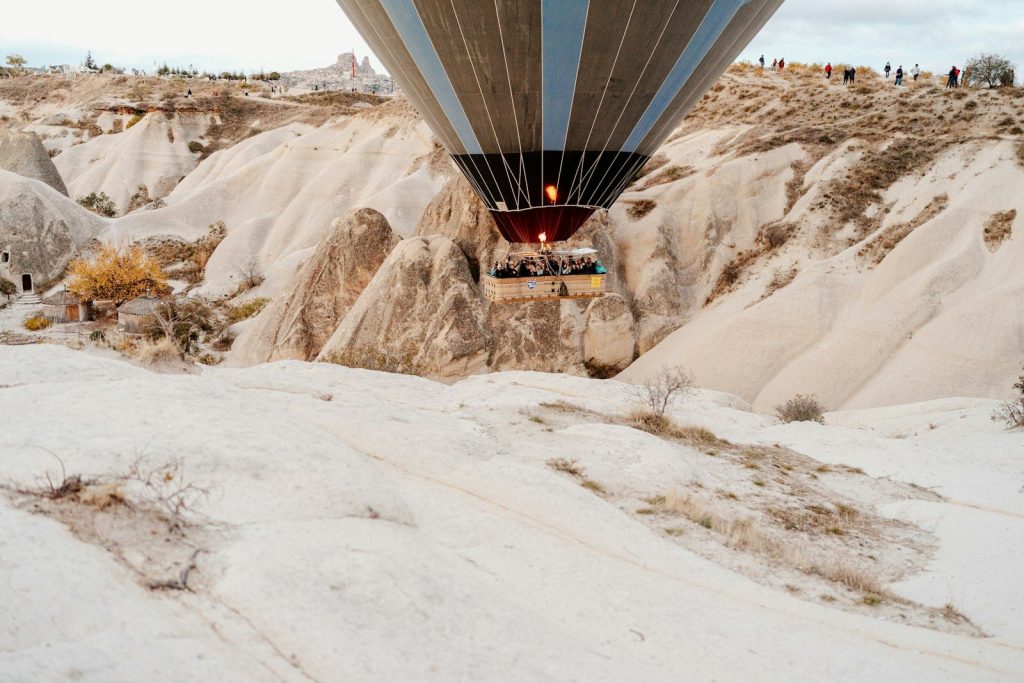
If you would rather see the live bookable list than do the probabilities yourself, the flights currently on offer in the region are in the panel below — the same balloons that produce these numbers, with availability shown for your dates.
If Your Flight Is Cancelled: What You Actually Get
This is the section we would want to read before booking, and it is the one every competitor skips. A cancellation is not a loss of your money in the ordinary case; it is a choice between two remedies, and the choice you make depends entirely on where in your trip the cancellation lands.
The standard remedy, in the operator’s own words. A major Cappadocia operator states its policy plainly: if the flight is cancelled due to weather conditions, you receive a full refund; and you can reschedule your flight for the following morning, subject to availability. The same page adds that in a weather cancellation there is no cost to you of any kind (source: Voyager Balloons booking terms, retrieved 2 October 2026). Most established operators work to the same two options, though the exact wording differs, which is why the first thing to check is the cancellation clause on the specific listing rather than the general reputation of the company.
How to choose between refund and rebook:
| Your situation | Better remedy | Why |
|---|---|---|
| Flight was scheduled early in your stay | Rebook | You are still in Cappadocia, the next morning exists, and you may end up flying in better light |
| Flight was your last morning | Refund | There is no next morning — the rebooking option is worthless to you |
| You have a fixed onward flight or bus | Refund, or rebook only if the transfer can move | A successful rebooking you cannot attend is not a solution |
| You are flexible on dates but not on budget | Rebook | A rebooking is normally at no extra cost; a refund sends you home without the flight |
| The operator offers a partial flight or an alternative route | Ask what “alternative” means | A shortened flight or a substitute activity is not the same product as a sunrise flight |
What insurance does and does not do. This is where travellers most often assume cover they do not have. Standard travel insurance is built around unforeseen events, and a weather-dependent flight being grounded is, from an insurer’s point of view, a foreseeable possibility rather than an accident. Rather than rely on a general claim about what is covered, we would put two specific questions to your insurer in writing before you travel: does the policy pay out for a cancelled hot-air balloon flight, and does it pay for a non-refundable hotel night you booked specifically to be in position for the flight? If the answer to either is vague, the practical move is to book flights and cave stays on terms that can be changed rather than to buy insurance against the weather.
The three things to do at the moment of cancellation. First, get the message in writing from the operator — a chat message or email stating that the flight was cancelled by decision of the aviation authority, which is the wording your insurer will ask for. Second, decide refund or rebook immediately, because the next morning’s seats are being reallocated to everyone else on your flight within minutes of the announcement, and the earlier you take the rebooking the better your date options. Third, if you rebook, rebook for the earliest available morning, not for your preferred one — you are buying additional attempts, not a nicer slot.
When it is nobody’s fault, and when it is worth pushing back. A grounding decided by the aviation authority is a safety call that the operator cannot override; no amount of complaining changes it. What you can hold a company to is the remedy itself: a full refund where a full refund is due, a rebooking where a rebooking is offered, and clear information about which of the two applies. If a listing is silent on weather cancellations, treat that silence as a reason to book elsewhere rather than a detail to sort out later — the terms are the product.
Finally, a note on how to fold a possible cancellation into the rest of the itinerary rather than treating it as a disaster. The morning you lose to a grounding is still a morning in Cappadocia, in daylight, with the weather that grounded you. The next section is what to do with it.
What Still Runs When Balloons Don’t
A grounded morning in winter is not a wasted day, and the instinct to rebook everything or drive to another town is almost always wrong. Cappadocia has a full second layer of things to do that do not care about wind: they are indoors, underground, or sheltered, and several of them are better in winter than in summer because you are not competing for space.
The list, ordered by how well it survives bad weather:
1. The underground cities. Derinkuyu and Kaymaklı are the obvious wet-and-windy-day answer, and unlike the valleys they are not subject to wind. Derinkuyu extends to roughly 85 m below the surface across multiple levels, with ventilation shafts engineered so that no two levels align — the airflow design is one of the more remarkable things you will see in the region (source: Derinkuyu entry on Wikipedia, retrieved 2 October 2026). We looked for a published winter air-temperature figure and did not find one we could stand behind, so we will not invent a number: what is true is that you are deep in rock, out of the wind, and moving through narrow tunnels, which is a different experience from standing on a ridge.
2. A hamam. A Turkish bath is the single best bad-weather afternoon in Cappadocia and the one winter activity with no weather dependency at all. Göreme, Ürgüp and Nevşehir all have traditional hamams; the classic sequence is steam, scrub, rinse, rest, and you want ninety minutes rather than the thirty a hurried visitor gives it.
3. The valleys in snow, on foot, on the sheltered side. Snow does not close Love Valley or the paths out of Çavuşin; it closes specific icy sections. Snowshoes are available in Göreme in a good snow year, and the walks that run along the valley floors or between villages are far more sheltered from wind than the ridge viewpoints.
4. Göreme Open Air Museum. A cluster of rock-cut churches with frescoes under overhangs — covered, walkable, and in winter effectively uncrowded. Budget an hour and a half, and expect some paths to be gritted rather than cleared.
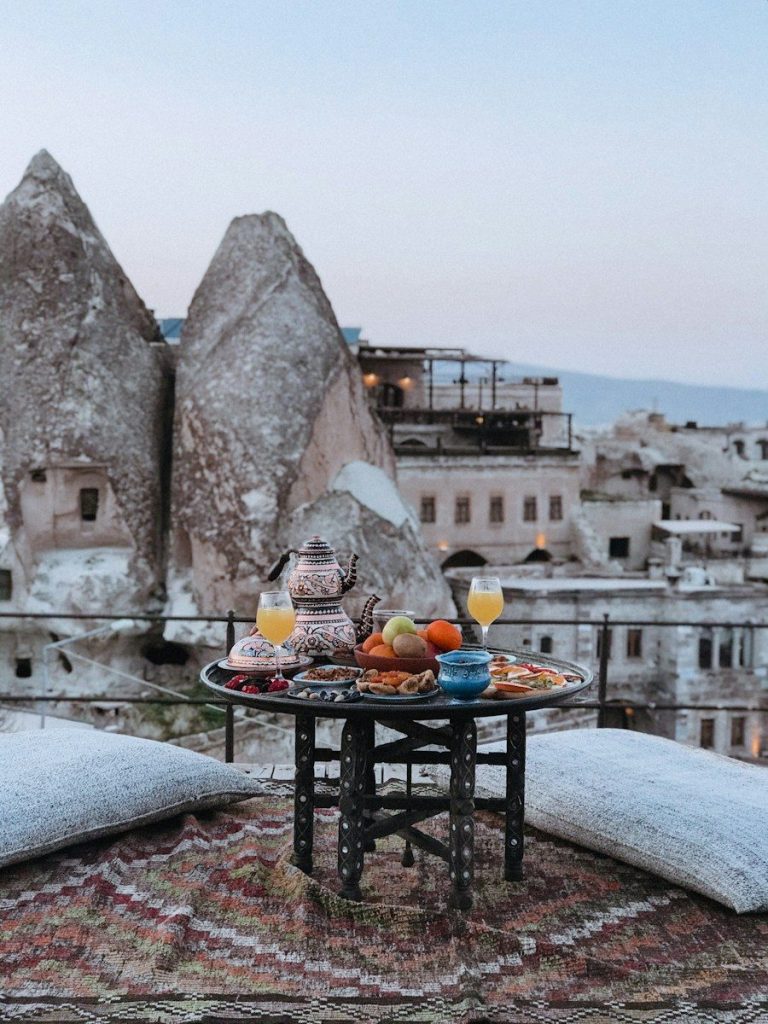
5. The cave hotels themselves. A winter afternoon in a cave room with a fireplace and a window onto falling snow is the thing people remember about a January trip more often than the flight. Build one deliberately lazy afternoon into the itinerary instead of filling every hour.
6. A Turkish night show. Dinner, music and dancing in a carved hall — indoors, no weather risk, and a reasonable substitute for a cancelled balloon evening.
7. Pottery and the craft towns. Avanos workshops on the Kızılırmak, the onyx and jewellery workshops around Ürgüp — all indoor, all good in a snow squall, and all considerably calmer in winter than in July.
8. A day trip to a neighbouring valley or town. Soğanlı, Mustafapaşa, Ihlara — the last is a canyon walk with its own microclimate and a stream, and often feels a season milder than the plateau it cuts through.
Two things to be careful about when you reroute a grounded morning. First, do not over-commit to a long drive in marginal snow — the value of a flexible morning disappears if you spend it on a road that turns out to be slow. Second, do not treat the substitute as a poor version of the flight. The balloon is the headline, but the underground cities and the hamam are reasons people come to Cappadocia in their own right, and a trip that flies on day two and explores on day one is not a compromised itinerary — it is a better one.
If you want the cancelled morning to be organised rather than improvised, the regional experiences above can be booked in advance alongside the flight, which also gives you something to switch to at short notice: browse Cappadocia tours and experiences with live availability.
Where to Stay in Winter
The winter accommodation decision is different from the summer one, and the difference is not price. It is heat, access and slope.
In summer, a cave room in Göreme or a stone house in Ürgüp is largely a matter of taste. In winter, three practical factors decide whether you enjoy the trip: how well the room holds heat, how far you are from where a balloon pick-up happens, and how steep the street outside is when it is icy.
The cave-room question. Carved rock rooms are genuinely warm in winter — the rock mass buffers temperature, and a well-run cave hotel is comfortable even when the outside is below zero. The variable is not the cave but the heating system: underfloor heating plus a wood-burning stove is the combination to look for, and a room with only an electric panel heater in a large carved space can feel cold in the small hours. Ask directly what heats the room, and ask whether the heating is included or metered.
Village by village, in winter terms:
| Area | Winter character | Balloon pick-up | Watch out for |
|---|---|---|---|
| Göreme | Cave hotels, restaurants, walkable centre; the classic base | Easiest — most operators start here | Streets climb; some side lanes stay icy after a snow event |
| Uçhisar | Highest, best views, quietest, colder and windier | Slightly longer transfer | Exposed position; the wind you feel is the wind that grounds the fleet |
| Ürgüp | Traditional stone houses, more of a living town, good restaurants | Easy | The centre is hilly; a hotel on the outer ring means a car for evenings |
| Çavuşin / Avanos / Ortahisar | Cheaper, more local, often charming | Longer transfers, sometimes a supplement | Fewer open restaurants in deep winter — check before booking |
Three winter-specific questions to ask before you book. Is the hotel open in your dates (a minority of small properties close for maintenance between December and February, and listing pages do not always reflect it)? Is the road to the door cleared, since a snowed-in lane in Ortahisar is charming in photos and not at 06:00 on a balloon morning? And is there a stove or underfloor heating in your specific room, not just “heating” in the amenities list?
One winter advantage worth using: because the season is low, upgrades are genuinely available. Asking for a better cave room, a fireplace, or a valley-view window is far more likely to succeed in January than in July, and the same flexibility applies to changing dates if your flight gets pushed.
What a Winter Trip Costs — and Why We Print No Prices
We do not put prices in our articles, and that is a deliberate editorial decision rather than an oversight. Two reasons.
The first is honesty about volatility. Cappadocia’s pricing moves with the season, with the exchange rate, and with how far ahead you book. A figure written into an article in October is a figure that misleads someone reading the same page in January, and a range is only marginally better — it looks precise while being equally unreliable. We would rather tell you what drives the cost than pretend to know the number on your dates.
The second is that a stale number is worse than no number. Published prices in travel content have a habit of being copied between sites for years without anyone re-checking them, which is how so much published Cappadocia pricing is quietly wrong. Live availability, by contrast, is correct by construction.
What actually drives the cost of a winter trip to Cappadocia:
- The balloon flight itself, which is the single largest line item and the most seasonal. Winter is cheaper than summer for the obvious reason: fewer travellers, and more mornings that might not fly. Anything that changes the product — private basket, longer flight, smaller group, hotel pick-up — changes the number.
- Your dates within the season. The last week of December and the first days of January behave like a mini high season because of domestic travel; the first half of January and all of February are the value window.
- How far ahead you book. Winter rewards late booking for hotels, because inventory is wide and rooms are discounted closer to the date. It does not reward late booking for a specific cave room or a specific Christmas week.
- Nights, not days. The cost of the trip is driven by how many mornings you are physically present for, and a two-morning balloon buffer means one more night. That night is cheap in January and worth more than most of your other spending.
- Transfers and internal transport. Arriving at Kayseri or Nevşehir and staying in a village adds transfers; winter road conditions occasionally add time.
- What you do instead of the flight, if it is grounded. This is a real budget line in December and January, not a rounding error.
If you want the cost structure of a Turkey trip as a whole — flights, internal transport, hotels, food — rather than the Cappadocia slice, that breakdown is on our Turkey trip cost guide. For the balloon specifically, the seasonal pattern by month is here: Cappadocia hot air balloon price by month. Both use the same rule we do: drivers and relative tiers in prose, live figures in the booking panels.
What to Pack for Cappadocia in Winter
Cappadocia in winter is not an extreme cold destination, and the mistake most people make is packing for the temperature instead of for the combination of cold, wind and standing still at dawn. A 4 °C morning at a launch field with a breeze is colder in practice than a −4 °C afternoon walking a valley, because you are not moving.
| Layer | What to bring | Why it matters here |
|---|---|---|
| Base layer | Merino or synthetic thermal top and bottom — not cotton | Cotton holds sweat and turns cold the moment you stop, which is exactly what happens at the launch site |
| Mid layer | Fleece or light down jacket | This is the layer you will live in during the day; two thin ones beat one thick one |
| Shell | Windproof and water-repellent outer jacket | Wind is the reason flights get cancelled and the reason you feel cold; windproofing does more than extra insulation |
| Legs | Thermal base plus trousers; waterproof over-trousers if you plan valley walks | Snow on the paths is wet at the ankle and dry at the knee |
| Footwear | Waterproof boots with deep tread and ankle support | The single most important item in January. Icy paths are a safety issue, not a comfort one |
| Extremities | Gloves (liner plus outer), beanie, buff, warm socks | Fingers go first when you are standing still holding a camera at sunrise |
| Sun | Sunglasses and high-factor sunscreen | Clear winter days on the plateau are bright, and snow reflects the light upward |
| Practical | Power bank, spare camera battery, small torch or headlamp | Batteries lose capacity in the cold, and winter daylight ends early |
| Optional | Chemical hand warmers, thermos flask | The difference between enjoying a grounded sunrise and hating it |
Three things people forget. A buff or balaclava, because the wind at a launch field gets to your neck and face. A small daypack rather than a handbag, so your hands stay free on unsteady ground. And cash in local currency, because a few smaller businesses in the villages still prefer it and cash machines are not on every corner in deep winter.
What you do not need. Specialist mountaineering gear, crampons, or an expedition parka. Cappadocia’s winter is a plateau winter — cold, often windy, occasionally snowy — in a region where the towns function normally all season. The goal is a layering system you can strip down at midday and rebuild for the launch field, not survival kit.
One rule for the balloon morning specifically. Dress for an hour outdoors before sunrise, not for the afternoon you just had. The pick-up is early, the field is open, and you will be standing still through the inflation. If you take one extra item, make it an extra layer for your legs.
Getting There in Winter
Cappadocia has two airports and winter changes both, plus the road question that most guides ignore.
Kayseri Erkilet (ASR) is the larger of the two, roughly an hour to Göreme by road, with more frequent flights and better connections via Istanbul. Nevşehir Kapadokya (NAV) is closer — around forty minutes to Göreme — but with fewer flights and a thinner winter schedule. The practical winter rule is to favour the airport with more flights, because a cancellation at Nevşehir can mean a long wait while Kayseri usually has an alternative later the same day.
Snow and the roads. The main roads between Kayseri, Nevşehir, Ürgüp and Göreme are cleared and gritted through the winter and closures are rare rather than routine. The roads that catch people out are the smaller ones: village lanes, the approach to a remote cave hotel, and the launch-site tracks after a heavy overnight fall.
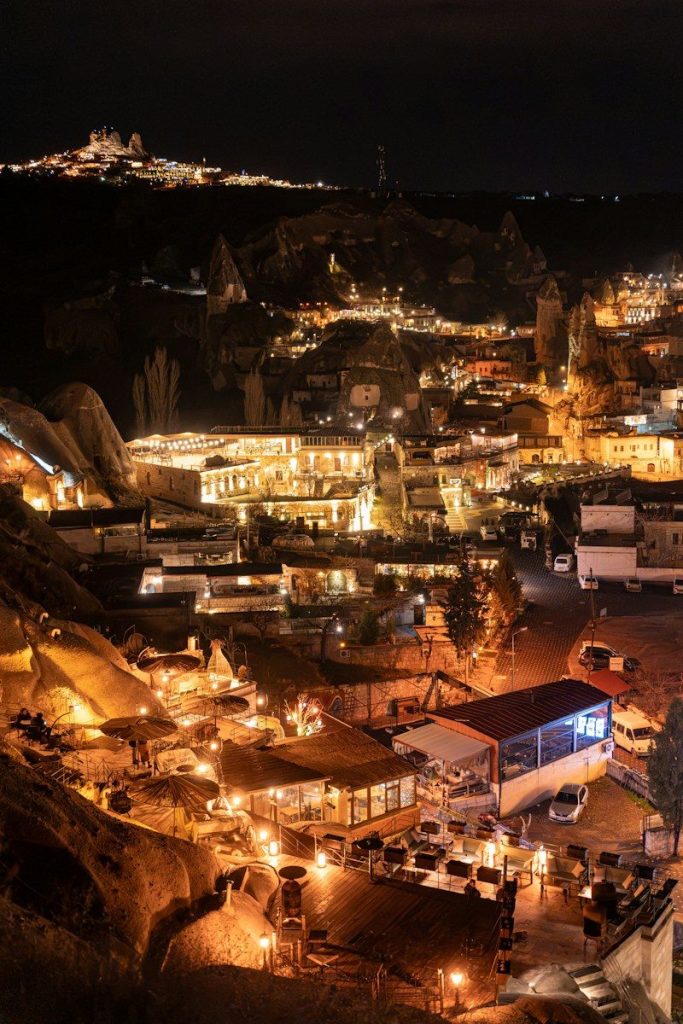
If you are self-driving, this is the argument for a car with proper winter capability and for checking the route to your specific hotel rather than the route to the town.
Self-driving versus transfer, in winter terms. A transfer is the lower-risk option for most travellers: you are not the one deciding whether a lane is passable at 06:00, and the operator’s driver knows the launch sites. A hire car wins on flexibility for the rest of the trip — day trips to Soğanlı or Ihlara, chasing a break in the cloud, going out to the viewpoints at sunset. If you drive yourself, the specific winter items to confirm are winter tyres, snow chains if your route goes higher, and whether your rental agreement covers driving on snow.
Domestic transport worth knowing. Overnight buses from Istanbul are cheap and comfortable but land early in the morning — convenient if you are flying that morning only in principle, not in practice. The Istanbul-to-Cappadocia flight-and-ground logistics are set out in detail on our 7-day Istanbul to Cappadocia itinerary, including how to sequence the balloon morning so a travel day does not eat it.
One scheduling rule for winter arrivals. Do not book a balloon flight for the morning you land, and do not book it for the morning you leave. Weather delays on the inbound leg and early departures on the outbound one both kill the flight you paid for, and neither is the operator’s fault. Give yourself a full day in the region before you expect to fly.
Is Cappadocia Worth It in Winter?
Short answer: yes, for a specific kind of traveller, and no for another. We would rather tell you which is which than sell the season to everyone.
Winter is the right choice if you are:
- A photographer. Snow on the chimneys, low sun angles, empty viewpoints and dry, clear air are the conditions Cappadocia’s best images are made in. In summer the same viewpoints at sunrise are a crowd with tripods.
- Allergic to crowds. January is the quietest month of the year here. Walking a valley in snow with nobody ahead of you is the experience people describe when they say the place feels unreal.
- Flexible and happy to build a buffer. If you can give the balloon two mornings and shrug at a grounded day, winter is strictly better value than summer: cheaper rooms, better light, the same landscape.
- Travelling for atmosphere rather than a tick-list. Cave hotels with stoves, hamams, long dinners, snow falling outside a carved window — this is a winter product, and summer does not offer it.
- On a budget. Low season rates for the same cave rooms are the largest single saving available in a Turkey trip.
Winter is the wrong choice if you are:
- Flying in for one night to tick off the balloon. One morning in December or January is a coin-flip at best, and a coin-flip is a bad way to spend a long trip’s centrepiece.
- Unwilling to change plans. If a grounded morning ruins your trip rather than redirecting it, the season will find you out. The weather does not negotiate.
- Looking for warmth, hiking at volume, or long days. Daylight is under ten hours; that is a real constraint on how much you can see.
- Driving a route that depends on mountain roads in the east. That is a separate trip with separate risks, and it is not this one.
- Travelling with someone who feels the cold badly. Nobody enjoys Cappadocia from inside a hotel room.
The honest verdict. Winter trades certainty for atmosphere. You will almost certainly get a better-looking Cappadocia and a cheaper one; you may not get the flight on the morning you first planned. If the balloon is the entire point of the trip and you have exactly one morning to give it, come in spring or autumn. If the balloon is the highlight of a trip that has other things in it, winter is the more interesting season — and with a two-morning buffer, the odds are strongly in your favour.
Practical Logistics
Daylight is the constraint that shapes a winter itinerary. Here is the actual sunrise and sunset for Göreme at mid-month, computed for its coordinates at Turkey’s fixed UTC+3:
| Date | Sunrise | Sunset | Usable daylight |
|---|---|---|---|
| 15 December | 07:51 | 17:20 | 9 h 29 m |
| 21 December (solstice) | 07:55 | 17:23 | 9 h 28 m |
| 15 January | 07:57 | 17:43 | 9 h 46 m |
| 15 February | 07:32 | 18:18 | 10 h 46 m |
The practical reading: in December and January you have roughly nine and a half hours, which is one major site plus one valley walk plus a sunset viewpoint, and not much more. Plan the day around a late-morning to mid-afternoon core, use the early dark for hamams, dinners and cave-hotel time, and do not schedule two distant sites in one day.
Opening hours and tickets. Many Cappadocia sites run shorter winter hours than their summer schedules, and a few reduce days. We are deliberately not printing specific times, because institutional hours change between seasons and a wrong time is worse than a link: check the official museum site or ask your hotel the day before you go. Tickets for the Göreme Open Air Museum and the underground cities are separate, and the museum pass that covers multiple sites is generally the better deal if you plan to see more than two — but confirm what it includes on your dates, because coverage changes.
Money and cards. Cards are widely accepted in Göreme, Ürgüp and Nevşehir; smaller villages, rural cafés and some workshops are cash-friendly. Carry a modest amount of local currency and use bank machines in towns rather than relying on village ATMs.
Connectivity. Mobile coverage is good in the towns and patchy in the valleys. A local data plan is cheap and makes the difference for checking the flight status at 05:30, which is exactly when you need it.
Language. English is widely spoken in the tourism villages and much less so in Nevşehir’s everyday shops. A handful of Turkish phrases — greetings, thanks, “no” and numbers — is appreciated and occasionally useful.
Health and safety, winter-specific. The genuine risks are ice on paths and cold on a launch field, not altitude or wildlife. Boots with tread are the mitigation for the first, layers for the second. Valley walks in snow should be done in daylight and on the popular routes rather than alone on unmarked ones, and phone signal should not be assumed in the valleys.
What to confirm the night before anything important. The balloon status message, your pick-up time, whether your chosen site has winter hours that day, and the road to your hotel if snow fell. Fifteen minutes of checking at dinner saves the following morning.
FAQ: Cappadocia in Winter
Does it snow in Cappadocia in winter?
Yes, in most winters. Snow in the region typically arrives in events rather than continuously, starting around mid-December in a normal year and settling because the plateau stays below freezing. On the published Nevşehir records, December is the wettest of the three winter months and January the coldest, which is why a white Göreme is a realistic expectation rather than a rarity. We give no average snow-depth figure because no reliable monthly series exists for the basin at the resolution that would make it meaningful.
How cold does Cappadocia get in winter?
Nevşehir’s records show a typical January high of 4.1 °C and a night low of −3.5 °C, with the mean sitting at freezing; Kayseri, an hour east and a little higher, runs colder at night, near −5.4 °C. December and February are milder at the top of the day, around 6 °C. The number that matters more is the wind chill at a launch field before sunrise, which is why we treat layers as equipment rather than comfort.
Do hot air balloons fly in Cappadocia in winter?
Yes — flights run year-round, and cold is not the obstacle. Wind is. Flights are approved daily by the Turkish civil aviation authority, and they are grounded when wind speed exceeds the safe limit, when wind direction is unstable, when visibility is poor, or when the weather changes suddenly. A sunny, snowy, still morning flies; a mild, gusty one does not. Because decision-making is daily, cancellations can happen even in high season and even on clear mornings.
Cappadocia balloon cancelled — what do you actually get?
The standard remedy is a full refund or a rebooking for the following morning, subject to availability — the wording a major Cappadocia operator uses is that in a weather cancellation there is no cost to the traveller of any kind. Choose according to where the cancellation falls in your trip: rebook if you still have mornings ahead of you, take the refund if the cancelled morning was your last. Get the cancellation in writing, and decide immediately, because the next morning’s seats are reallocated fast.
Is Cappadocia in winter worth visiting?
For most travellers who can build in a buffer day, yes. You get snow on the fairy chimneys, the quietest valleys of the year, the lowest room rates and the best photographic light, in exchange for short daylight and a weather-dependent balloon flight. It is the wrong choice if you have exactly one morning to fly and nothing else in the trip, or if cold and early nights would spoil it for you.
What is there to do in Cappadocia when the balloons do not fly?
More than most itineraries allow. The underground cities at Derinkuyu and Kaymaklı are the best bad-weather option, followed by a hamam, the covered rock-cut churches of the Göreme Open Air Museum, pottery workshops in Avanos, a Turkish night show, and valley walks on the sheltered lower paths. All of these are indoor or wind-sheltered, and several are better in winter because they are not crowded. The regional experiences can also be pre-booked so a grounded morning has a ready plan: see Cappadocia tours and experiences.
Are the underground cities cold in winter?
They are not exposed to the weather at all — you are inside rock, out of the wind, moving through tunnels, which makes them the reliable choice on a windy or wet day. Derinkuyu descends to roughly 85 m across multiple levels and is cooler in feel than the surface on a mild day but far warmer than a launch field at dawn. We did not find a published winter air-temperature figure for the chambers, so we are not going to quote one.
How many days should I spend in Cappadocia in winter?
Three nights is the sensible minimum, and the reason is arithmetic rather than sightseeing: with one balloon attempt per morning, three nights gives you three chances, and the jump in your odds of flying between one attempt and two is large. Two nights is workable in February; in December and January, three nights plus a free final morning is the shape we would book.
Is Cappadocia crowded in December?
Not for most of it. The first three weeks of December are genuinely quiet — wide hotel availability, easy restaurant tables, empty viewpoints. The last ten days flip because of New Year and domestic travel, and cave-hotel rates for 30 and 31 December move toward summer levels. If quiet is what you want, aim for the first three weeks.
What should I pack for Cappadocia in winter?
Thermal base layers in merino or synthetic rather than cotton, a fleece or light down mid layer, a windproof and water-repellent shell, and waterproof boots with deep tread and ankle support — the boots are the single most important item, because ice on the paths is a safety issue rather than a comfort one. Add gloves, a beanie, a buff, warm socks, sunglasses and sunscreen for bright snow days, plus a power bank and a spare camera battery, since cold drains batteries. Bring one extra layer for your legs specifically for the balloon morning.
January or February — which is better?
January is colder, quieter, clearer and cheaper, with the most settled snow and the most wind; February is slightly milder, has roughly an hour more daylight, and is still low season until the final week. Photographers tend to prefer January for the clarity and the emptiness; travellers who want a longer usable day and marginally easier conditions tend to prefer February. Both are strong choices, and February’s extra light is the more practical advantage.
Do I need winter tyres to drive in Cappadocia in winter?
On the main roads between Kayseri, Nevşehir, Ürgüp and Göreme, snow is cleared and gritted and closures are uncommon. Where winter capability earns its money is the smaller roads: village lanes, steep approaches to cave hotels, and launch-site tracks after a heavy fall. If you hire a car, confirm winter tyres, ask about chains if your route goes higher, and check that your rental agreement permits driving in snow.
Can I book a balloon flight at short notice in winter?
Usually yes, because winter demand is lower — but short-notice booking also means fewer mornings left to absorb a cancellation, which is the trade you are making. The better strategy is to book the flight for your first or second morning, keep a spare morning unbooked, and use the low-season flexibility for the hotel rather than the flight. If you want a specific Christmas or New Year date, book that early and separately. Availability and current options for the flight are here: check Cappadocia hot air balloon availability.
How much does a winter trip to Cappadocia cost?
We do not print prices, because seasonal and exchange-rate movement makes any figure in an article unreliable by the time you read it. What we can tell you is the structure: the balloon flight is the largest line item, the first half of January and all of February are the value window within winter, cave rooms are meaningfully cheaper than in summer, and a two-morning buffer costs you one extra night, which is the cheapest insurance in the whole trip. Live figures for your dates are in the booking panel, and the wider cost breakdown is on our Turkey trip cost guide.
Final Thoughts
Cappadocia in winter is the version of the place that rewards the traveller who plans properly and punishes the one who assumes. The landscape is at its most photogenic, the valleys are quiet enough to hear snow slide off a rock, and the cave hotels turn into somewhere you actively want to spend an evening. What it does not offer is a guarantee, and any guide that promises you a sunrise flight is selling you something the operator cannot deliver — the approval is made by the aviation authority, an hour before lift-off, on the morning itself.
So take the season seriously in the two places it counts. Book the balloon for your first or second morning, not your last, so a cancellation moves you forward instead of ending the attempt. Keep the morning you lose. The underground cities, the hamam, the snow-covered paths and the covered churches are not consolation prizes; on a winter trip they are often the parts people talk about afterwards. And read the cancellation terms on the specific listing before you pay, because the refund-versus-rebook remedy is the one thing you genuinely control.
Do that, and the arithmetic is on your side. Two mornings, a good coat, and a flexible plan will get you the snow, the silence and the flight far more often than not — and if you want to see the alternatives and the flights side by side before you commit, the bookable list is here for Cappadocia tours and experiences and here for the balloon flights themselves. That is the trade Cappadocia in winter offers, and for the traveller who plans for it, it is a good one. The season this region was best photographed in is the one most people skip — go with your eyes open and it will be the trip you remember.