Sapporo Snow Festival 2027: Dates, Sites and How to Plan Around Them
Affiliate disclosure: Some links in this guide are affiliate links. If you book a tour or an experience through one of them, this site may earn a commission at no extra cost to you. Nothing here is paid placement, and no operator has been given the right to review or approve a line of this text.
The Sapporo Snow Festival 2027 runs from Thursday 4 February to Thursday 11 February — eight days, three sites, and a set of dates that are already settled. What is not settled, as of early October 2026, is the detail: the official pages carry the 2027 dates but still describe individual attractions with last season’s programme, and the organising committee says that content will be refreshed around mid-December 2026. This guide separates the two, so you can book against the dates without believing a single line of programme copy that has not been updated yet.
How We Built This Sapporo Snow Festival 2027 Guide
Every figure in this guide comes from an official source, and the distinction between a confirmed arrangement and a seasonal pattern is kept throughout. The dates and the block-by-block distribution of the park are taken from the organising committee’s own announcement for the 77th edition (July 2026) and from the closing notice of the 76th edition, both read on 7 October 2026. The climate figures are the Japan Meteorological Agency’s 1991-2020 normals for Sapporo, station 14163, drawn from the agency’s monthly normals archive on 7 October 2026 — they describe what February normally does, not what your particular week will do. The sunrise and sunset times are the National Astronomical Observatory of Japan’s published tables for Sapporo for 2027, read on the same day. Attendance numbers, results, safety measures and site counts come from the committee’s own reports and announcements on the 76th edition, from the city of Sapporo’s tourism statistics, and from Japan’s national tourism agency. Where a detail describes how the 2026 edition was arranged rather than a confirmed 2027 arrangement, it is labelled as such: the committee states that 2027 content will be updated from around mid-December 2026.
Why 2027 Is Not a Repeat of 2026
The 77th edition opens on a Thursday and closes on a Thursday, and the shape of the week matters more than the eight-day headline suggests.
It is eight days, and the dates apply to every site. The committee’s July 2026 announcement — and the closing notice from the previous edition — give the same window for Odori, Tsudome and Susukino: Thursday 4 February to Thursday 11 February 2027, described as eight days. There is no site that opens late, and there is no site that closes early. Any plan that treats Tsudome as a partial-week venue is planning for a festival that does not exist.
The closing day is a national holiday. Thursday 11 February 2027 is a Japanese public holiday, which doubles as the last day of the festival. That combination is the single most predictable crowd generator of the week, and it is the day to book around rather than into.
Lunar New Year falls inside the week. New Year’s Day in 2027 is Saturday 6 February, with the eve on Friday 5 February. The holiday calendars that send the largest short-haul winter traffic to Hokkaido — Taiwan and Hong Kong — place their long break across 5 to 14 February. The practical consequence is that the first weekend of the festival and the Lunar New Year holiday are the same weekend, and the days either side of it behave like a peak season rather than a normal February week.
The weekend structure is lopsided. In 2026 the festival ran Wednesday to Wednesday. In 2027 it runs Thursday to Thursday, which puts one full weekend (6 and 7 February) in the middle and leaves the closing holiday on a Thursday at the far end — two separate peaks rather than one.
A separate event extends the run. Sapporo Snow Sports Park 2027 is scheduled for 12 to 14 February at the Daiwa House Premist Dome, three days immediately after the festival closes. If your dates are flexible, that is an argument for adding a night or two rather than flying home on the twelfth.
Weather, not the calendar, decides the day. The committee’s own results for the 2026 edition record that heavy snow through the afternoon and evening of Friday 6 February and Sunday 8 February 2026 held attendance down, while Saturday 7 February was clear all day and drew the biggest crowds of the week; the edition still finished ahead of the previous year. Read that as the operating rule for any single day you pick: the date sets the likely crowd, the sky sets the actual one.
The Three Sites at a Glance
Three sites, one set of dates, three different reasons to go — and one thing they have in common, which is that you walk into all of them.
| Site | Dates | Hours that are published | Character | Best for | Access |
|---|---|---|---|---|---|
| Odori Park | 4–11 Feb 2027 | Park open through the period; illumination runs until 22:00 | Eleven blocks along the park, from winter attractions and a 2027 art-festival tie-in to the festival’s large snow sculptures and the international competition | First-time visitors; anyone wanting the classic images and the night light | Odori Station, directly on the Namboku, Tozai and Toho lines |
| Tsudome | 4–11 Feb 2027 | 10:00–16:00 | Snow play and family attractions in and around the Sapporo Community Dome, with indoor food and rest areas | Families with children; a half-day that does not depend on the weather holding | Toho line to Sakaemachi, then the shuttle; or about fifteen minutes on foot. No general parking and no drop-off point |
| Susukino | 4–11 Feb 2027 | Street open through the period; pedestrian-only hours vary by day type | Sixty ice works along Ekimae-dori between Minami 4-jo and Minami 6-jo, including the ice aquarium and the ice-carving competition | An evening; close-up ice rather than distance snow | Susukino Station, on the Namboku line |
Two practical notes on that table. Odori and Susukino are both public space, which is why the “hours” column is about lighting and about when the road closes to cars rather than about gates; Tsudome is the one site with a genuine opening and closing time and a queue system. And the access column is deliberately about mechanism, not timetables: the shuttle between Sakaemachi and Tsudome is a festival service, so its frequency is a detail to confirm locally on the day rather than a schedule to build a morning around.
Odori Park, Block by Block
Odori Park is not one venue with one entrance. It is the central park of Sapporo, running east to west through the downtown grid, and for eight days the festival occupies it from Nishi 1-chome to Nishi 11-chome — about 1,100 metres of park, eleven blocks, and somewhere between fifteen and twenty-five minutes of walking from one end to the other if you never stop. You will stop. The reason to look at the block map before you arrive is that the eleven blocks do not hold eleven versions of the same thing, and the organising committee’s announcement for the 77th edition sets out which block carries what: block 1 holds winter attractions, block 2 carries the tie-in to the Sapporo International Art Festival 2027, block 3 is given to the small snow sculptures, blocks 4, 5, 7, 8 and 10 each take one large snow sculpture, blocks 6 and 9 hold the medium and small works between them, and block 11 is the international snow sculpture competition.
Read that distribution carefully, because it is repeated wrongly in a great deal of secondary writing: the small snow sculptures sit in block 3, and the small and medium works together sit in blocks 6 and 9. Two of the eleven blocks are given over to works made by citizens and smaller groups rather than to headline sculptures, and that is where the humour of the festival lives — citizen works are entered into a public vote, and in the 2026 edition the committee counted seventy-nine of them across blocks 2 and 9, from school groups, company teams and neighbourhood associations.
| Block | In the 2027 plan | What the 2026 edition placed there | When to walk it |
|---|---|---|---|
| 1 | Winter attractions | A snow-board activity area, an aromatherapy foot bath and a medium-sculpture stage | Late morning — the hands-on attractions queue up as the day goes on |
| 2 | Sapporo International Art Festival 2027 tie-in | Citizen snow sculptures entered in the public vote, alongside small works | Midday, when the voting is busiest |
| 3 | Small snow sculptures | The Sapporo Smile plaza: a ticketed skating rink that ran from 28 January to 11 February in 2026, plus a decarbonisation zone with a free rest area and a free photo spot | Afternoon into the evening; the rink ran until 21:00 |
| 4 | Large snow sculpture | A thirteen-metre sculpture of a hollow clay figure, in the STV square | After dark, with the lighting on |
| 5 | Large snow sculpture | A thoroughbred scene in the Hokkaido Shimbun snow square, with projection mapping | Just before 17:30 to catch the projection (the 2026 start time) |
| 6 | Medium and small snow sculptures | A snow-art plaza made with the city’s art museum, plus the art festival’s pre-event tent | Mid-morning, before the sculpture queues form |
| 7 | Large snow sculpture | A university lecture hall built to mark a founding anniversary, in the HBC square | Dusk |
| 8 | Large snow sculpture | A castle keep in the HTB square, projection-mapped at night | Dusk to 22:00 |
| 9 | Medium and small snow sculptures | Citizen snow sculptures entered in the public vote | Midday |
| 10 | Large snow sculpture | A family land with a film-tie-in sculpture, in the UHB square | Late morning if you have children with you |
| 11 | International snow sculpture competition | Ten national teams carving on site | Mornings, when the teams are working |
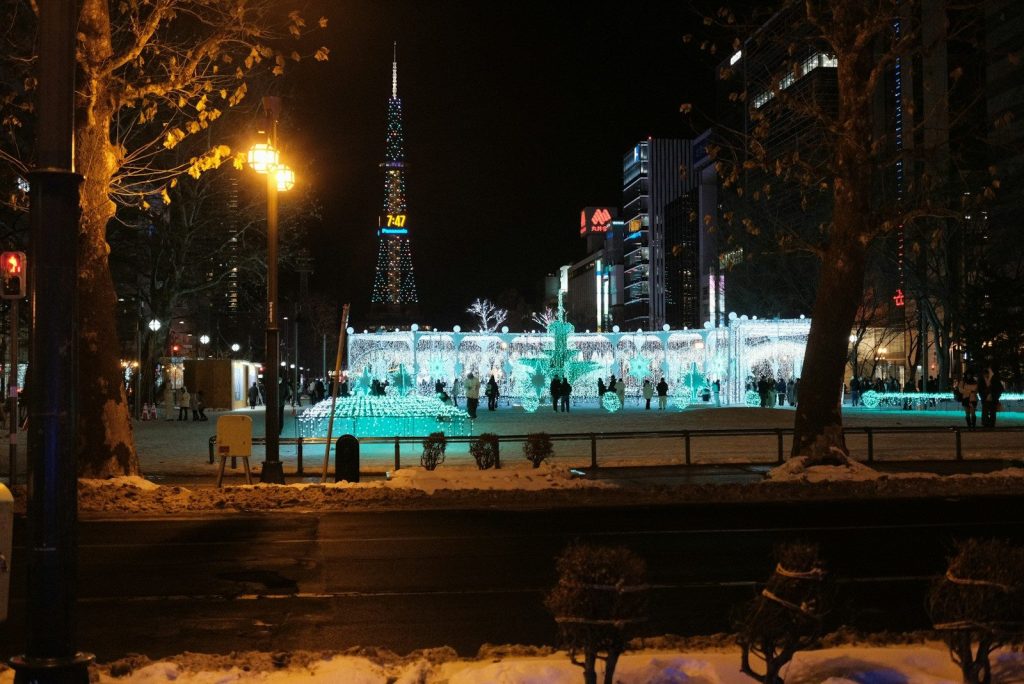
Three things about that park are worth knowing before you plan a single day around it.
The large sculptures are the western half. Blocks 4, 5, 7, 8 and 10 carry them, with blocks 6 and 9 holding the smaller citizen and medium works in between. If you have one evening at Odori, walk west from block 3 and keep going; you will pass all five large sculptures without needing a map. If you have one morning, the eastern end — blocks 1 to 3 — is the family end, with the activity areas, the skating rink and the crowds that come with them.
They are built from clean snow, brought in on a schedule laid down in January. The large sculptures are the work of the Ground Self-Defense Force’s festival unit together with the festival’s own large-sculpture production committee, with preparations that start around September and frames that go up from late December. Snow is packed into those frames in early January and the frames come off in mid-January, after which the carving and the finishing run to the last days before opening. The snow itself is transported from 7 January — the festival holds a transport opening ceremony that day — over about a fortnight, and the committee’s figures for a typical edition come to roughly 1,600 ten-tonne truckloads for the sculptures and a further 1,400 for Tsudome’s attractions. Ploughed street snow is deliberately not used: the force’s own engineering study found that snow containing impurities hollows out under sunlight and can end up structurally unsound, which is why the festival will pay to move clean snow from parks and dams in and around the city.
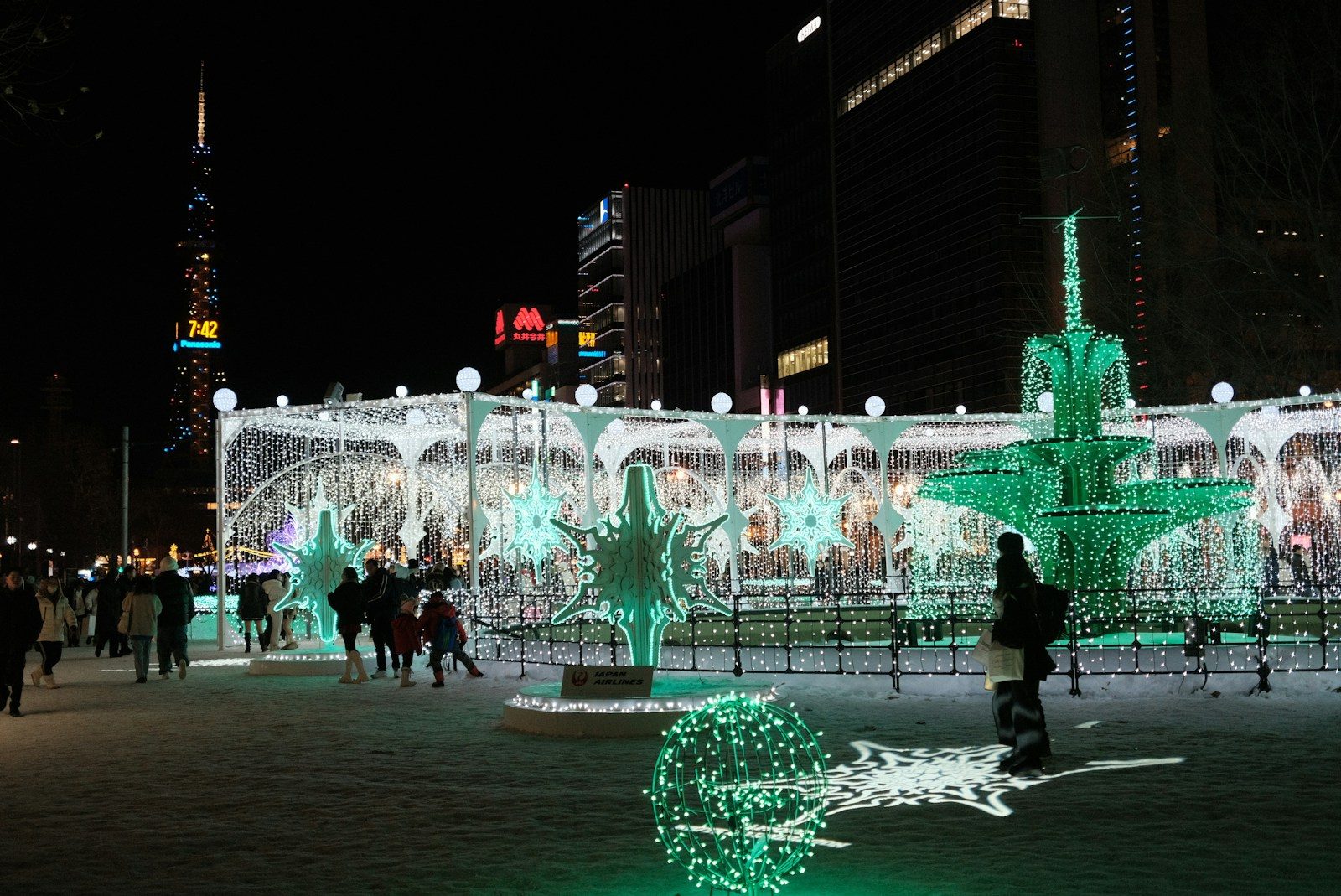
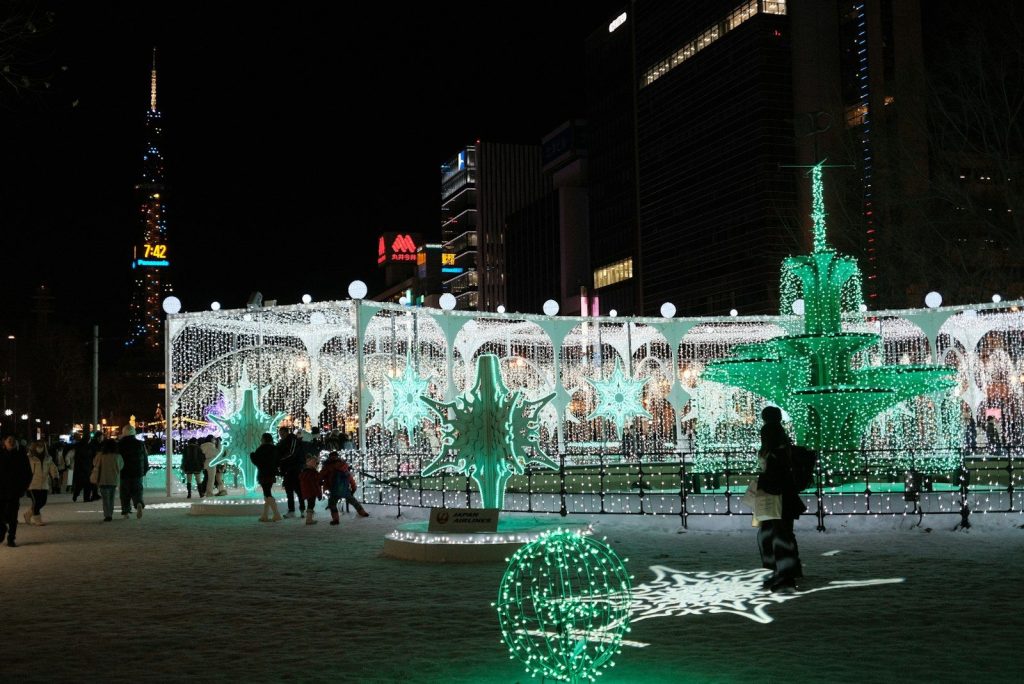
The park lights until 22:00, and the projections have their own timetable. In the 2026 edition, projection mapping ran every day from 17:30 on the two large sculptures at 5-chome and 8-chome — a detail worth remembering because it is the one part of the evening with a fixed start rather than a slow build. Illumination across the park runs until 22:00 on every day of the period. And because Odori is a public park rather than a ticketed enclosure, you can enter at any cross street, leave to warm up in a café or a department store, and come back — there is no gate to re-enter and nothing to show at the entrance.
A note on what is final and what is not. The block distribution above is the committee’s plan for 2027, announced in July 2026. Everything describing individual sculptures, plazas and programmes reflects the 2026 edition and is kept here because it shows the scale and the pattern of a normal year; the committee states that 2027 content will be updated from mid-December 2026. Plan your dates and your routes now; plan which specific sculpture you want to photograph in December.
Tsudome: the Family Day Out
Tsudome is the festival’s third site, in the east of the city at Sakaemachi, and it works differently from Odori in almost every way. It is built around the Sapporo Community Dome, a domed arena with the snow attractions laid out in the grounds around it, and it runs to a genuine timetable: open from 10:00 to 16:00, with a warning in the official guidance that reception for the attractions can close earlier than that when the site is crowded. If your children are going to remember one day of this trip, this is very likely the one — but it rewards a little planning more than Odori does, because some of what is here has a queue system and some of it has a rule you cannot talk your way around.
Start with the rule. Every attraction here requires a hat and gloves, and it is enforced as a condition of taking part rather than offered as advice. The site is exposed, the attractions involve handling snow and ice, and the official guidance is unambiguous that headwear and handwear are required for all of them. Bring them from the hotel even if the day looks mild.
Then the inventory, as the 2026 edition ran it: a tube slider where riders go down singly and the minimum age is four; a family tube that takes two riders together; a sledding slope where you can use your own sled or borrow one; snow play plazas with snowball games and a maze; a snow raft that requires a helmet; an ice slide; a mini snow foot-golf course; and photo spots built for children. A separate corner belongs to schools: in 2026 thirteen works from fourteen schools were built on site, and the carving of them could be watched until mid-afternoon on the opening day, which is a rare chance to see school teams at work rather than finished pieces.
Inside the dome is the other half of the day: a ticketed children’s play area, food booths serving Sapporo and Hokkaido dishes, warm rest areas for when hands and feet stop cooperating, a staffed luggage counter with a last acceptance time in the mid-afternoon, and a lost-child centre. One practical warning from the official guidance: the arena’s own toilets get very heavily used, and the outdoor toilets are usually the faster option.
| When you arrive | What the committee does with tube-slider tickets | What it means for you |
|---|---|---|
| Weekend or public holiday, site busy | First distribution at 10:00, releasing 1,500 tickets; the first 300 people of the day wait in the standby line and take no ticket | Be at the attraction when the site opens if the slider is the reason you came |
| Still busy around midday | Second distribution at 12:00, releasing 500 tickets | Arriving in the afternoon means asking at the entrance for the current number before you join anything |
| Any day | The running number and issuing times are posted at the attraction entrance; a ticket is valid only on the day it is issued | A ticket is a place in a queue, not a reserved minute — keep the rest of the day loose |
| Any day, site quiet | The committee may issue tickets earlier than planned, or open the attraction to everyone | On a quiet weekday the ticket system may not be operating at all |
Two more rules that are strictly applied, and both are about access rather than behaviour. There is no general parking at Tsudome and no drop-off point — the official guidance asks visitors to come by public transport, which in practice means the Toho line to Sakaemachi and then the festival shuttle, or about fifteen minutes on foot from the station. And across the whole site, drones and balloons are not permitted, pets are not allowed (assistance dogs excepted), and smoking is not allowed anywhere, including in a designated area, because there is none.
The scale of Tsudome is easy to underestimate from the guidebooks. In the 2026 edition it drew 613,000 visitors — about a tenth more than the year before — and carried fourteen snow and ice works, and the whole site is built out of roughly 1,400 ten-tonne truckloads of snow, which is the second-largest snow operation of the festival after the sculptures at Odori. It is also the one site you cannot walk into before the period begins: unlike the Susukino ice street, where the carving starts about three days before opening, the Odori and Tsudome sites are closed to visitors while they are being built.
The shape of a good day here is unglamorous and reliable. Arrive for the 10:00 opening, send whoever wants the tube slider straight to the queue for a ticket, spend the late morning outdoors while the light is at its best, eat inside at midday when the cold has done its work, and treat the afternoon as a second, slower pass — the indoor play area, the food booths, a last round of the outdoor attractions for whoever still has energy. Then leave by the time the site closes at 16:00, because on a February afternoon in Sapporo the light is already going by then.
Susukino Ice World After Dark
Susukino is the third site and the only one that is a street rather than a park. Sixty ice works are lined up along Ekimae-dori between Minami 4-jo and Minami 6-jo, along the west 3 and west 4 chome line — the main street of Sapporo’s entertainment district, closed to traffic so that people can walk it. The scale is smaller than Odori and the experience is entirely different: this is ice at arm’s length rather than snow at a distance, and the theme the city has used for it is ice you can enjoy and touch. The most photographed works are the ones with fish frozen inside them — an ice aquarium running the length of the street — and the pieces entered in the ice-carving competition.
The street is organised into four zones. A welcome gate and a principal sculpture at Minami 4 West 4 make the entrance; one zone is given to original ice works; one to the competition pieces; and one to a demonstration corner with a free photo-card service and an information point. The ice itself is made in a hurry and by hand: about two hundred people — chefs belonging to the city’s culinary association and the Hokkaido ice-carving association among them — work through the night for roughly three full days, because ice carves better when the air is below ten degrees of frost, and on warm nights they pack dry ice around a piece to hold it while they finish. The carving starts about three days before the festival opens, which is the one pre-festival window where you can watch work in progress: unlike Odori and Tsudome, the street is not closed off while it is being built.
| Day type | Road open to pedestrians in the 2026 edition | Which dates in 2027 fall into this type |
|---|---|---|
| Weekday | From 15:00 to 23:00 | Thursday 4, Friday 5, Monday 8, Tuesday 9 and Wednesday 10 February |
| Weekend | From 10:00 to 23:00 | Saturday 6 and Sunday 7 February |
| Final day | From 10:00 to 22:00 | Thursday 11 February, a public holiday |
That table is the 2026 pattern rather than a published 2027 timetable, and it is worth reading as a pattern rather than a promise — but the pattern is a useful one, because it tells you that a weekday visit is an evening visit and a weekend visit can start at breakfast time. Outside the pedestrian hours the ice works stay where they are along the street and can still be seen from the pavement; the official guidance is that the street’s works are free to view at any time during the period, with the lighting running until 23:00 except on the final day, when it stops at 22:00.
There are ceremonies, and they are spaced in a way that lets you plan a day around them. The opening ceremony is at 18:00 on 4 February, in front of the main ice sculpture at Minami 4 West 4. The ice-carving competition runs from 14:30 on 4 February to 10:30 on 5 February, with awards at 11:00 on 5 February — so the afternoon of the opening day is the best moment of the whole festival to watch ice being carved competitively, and the morning of the fifth is the moment to see the results before the crowd arrives. The closing ceremony is at 21:45 on 11 February, a quarter of an hour before the final evening’s lighting ends.
| Date | Time | What happens |
|---|---|---|
| 4 February | 14:30 onwards | The ice-carving competition begins on the street |
| 4 February | 18:00 | Opening ceremony in front of the principal ice sculpture |
| 5 February | 10:30 | Carving stops |
| 5 February | 11:00 | Awards for the ice-carving competition |
| 11 February | 21:45 | Closing ceremony, ahead of the last night’s 22:00 finish |
The safety story of this site is worth knowing, because it explains why the street is laid out the way it is. A gust of wind brought down ice works during the 2025 edition, and the measures introduced for 2026 were preventive: bases were lowered and fixed, daily inspections and sanding were added, and the distance between the works and the walking area was widened from 50 centimetres to 90 centimetres. During the 2026 edition, on the evening of 10 February, one work did collapse in a spell of warm weather. Nobody was injured, and the committee’s own account attributes that to the widened safety distance and to design considerations built into the pieces. In other words, the 90-centimetre gap is not a detail of the layout — it is the reason a collapse in the middle of a street festival ended with no casualties.
The numbers from the 2026 edition show both the appeal and the fragility of a street made of ice. Susukino drew 1,378,000 visitors, up by about a third on the 1,022,000 of 2025 and above the 1,136,000 of 2024, even though the site was reduced to about two-thirds of the previous edition’s scale. On the opening day, warm weather muted the ice: the pieces were up, but the light did not move through them the way it does in a hard frost. That is the argument for watching the forecast in the week you travel and, if you can, giving the site two evenings rather than one — a cold night in Susukino is a different sight from a mild one.
What Is Free (and What You Actually Need to Arrange)
The headline fact is the one that decides most budgets before the trip starts: entry to all three sites is free. The committee’s own guidance says the entrance fee is not applicable because every site is free — Odori Park and the Susukino street because they are public space, and Tsudome because the festival does not charge admission to the site. You can walk all eleven blocks of Odori, the full length of the Susukino ice street and the whole of Tsudome without buying a ticket of any kind, and the illumination at both Odori and Susukino is part of that free experience.
What is not free divides into two kinds of thing: attractions the festival itself sells, and the things you buy before you leave the hotel.
At Tsudome, some of the attractions and the indoor children’s play area are ticketed rather than free, and in the 2026 edition the skating rink at Odori was a ticketed addition run by a separate organising committee, which sold its tickets in advance and at the rink. Both are additions to a free festival rather than a gate in front of one: if you skip them entirely you will still have seen the festival. The same applies to food and drink, which is sold across all three sites.
| What you need | Free or paid | What to know |
|---|---|---|
| Entry to all three sites | Free | The official guidance states every site is free, throughout the period |
| Illumination at Odori and Susukino | Free | Odori lights until 22:00; Susukino until 23:00, except the final day at 22:00 |
| Tube slider and other Tsudome attractions | Free, with queue tickets | Hats and gloves are required for every attraction |
| Indoor children’s play area at Tsudome | Ticketed | A separate paid area inside the dome |
| Skate rink at Odori in the 2026 edition | Ticketed | Ran from 28 January to 11 February in 2026; a separate organising committee sold the tickets |
| Anti-slip attachments for boots | Paid | Sold at the festival’s official shop inside Odori, at nearby convenience stores and at JR and subway station kiosks |
| Walking poles | Free loan | Available at the festival’s official shop inside Odori Park |
| Multilingual printed guidance | Free | The committee printed a limited multilingual guide for the 2026 edition |
| Luggage storage during the festival | Paid service, opened by the city | The city opens temporary counters so visitors can leave bags while they walk the sites |
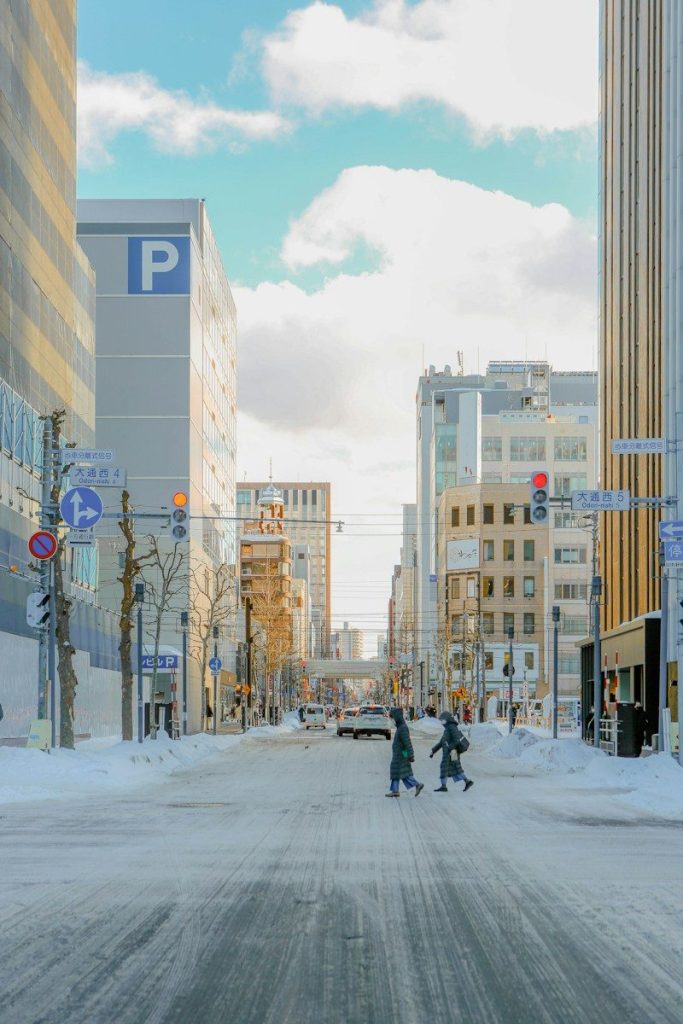
The second list is the one that catches people out, because it is not about money so much as about being prepared in a place where the temperature does not negotiate. What the official guidance says about clothing is unusually direct: Sapporo is at its coldest from late January into early February, the guidance recommends layering a shirt and a sweater under a proper coat or jacket, and it states plainly that a thin coat will not be enough. A hat, earmuffs and gloves are listed as necessary rather than optional, and for footwear the advice is that ordinary soles will not do on the frozen pavements that are normal here in February — grip-cut winter soles, or an attachment fitted over the boot, which is why the official shop, the convenience stores and the station kiosks all stock them. The festival also lends walking poles free of charge from the official shop at Odori, which is a small thing that changes how you feel about a two-hour walk on ice.
Two further practical items belong on the list. Cold shortens battery life dramatically, so a phone and a camera both need more charge than they would at home, and a power bank in an inside pocket is worth more than any accessory. And the last item is not an item at all: leave slack in the plan. Snow suppressed attendance on two of the eight days of the 2026 edition for the simplest possible reason, which is that people stay indoors when it is coming down hard, and the same weather that empties a site can also close a queue or soften the ice. Two evenings at Odori and two at Susukino, if your trip allows it, is a better plan than one perfect evening that the weather cancels. If the festival fortnight is your only window and it coincides with the crowds, the wider island is the answer rather than another night in the same park: the same deep winter, with drift ice, ice villages and ski bases instead of sculpture, is set out in our guide to Hokkaido in winter.
Weather in Festival Week, by the Numbers
Almost everything written about February in Sapporo is either generic or wrong, so here is the official version. The figures below are the Japan Meteorological Agency’s 1991–2020 climate normals for Sapporo, station 14163, taken from the agency’s own monthly normals archive on 7 October 2026. They are normals — a thirty-year average for the month, not a forecast for your week — but they are the best guide there is to what the eight days of the festival will feel like, because they say what February normally does.
| Sapporo, February — official 1991–2020 normals | Value | What it means during festival week |
|---|---|---|
| Mean temperature | −2.7 °C | Cold but not extreme: this is a working city in winter, not a polar camp |
| Mean daily maximum | 0.4 °C | Most days do get above freezing, usually for a few afternoon hours |
| Mean daily minimum | −6.2 °C | Evenings and early mornings sit well below zero; this is when you feel the cold |
| Days with the daily maximum below 0 °C | 13.3 | In a normal February, roughly two days in five never rise above freezing at all |
| Precipitation | 91.9 mm | Snowfall arrives in frequent, moderate episodes rather than one storm |
| Sunshine | 103.5 hours | About three and a half hours of sun a day on average — and that average hides stretches of flat grey |
| Maximum snow depth | 95 cm | Snow on the ground is the norm, and it is deep enough to change how the city looks and moves |
| Days with snow at least 10 cm deep | 28.3 | Effectively the whole month: you can plan on snow underfoot |
| Days with snow at least 50 cm deep | 26.0 | Deep snow is the ordinary state of the city, not the exception |
| Days with snow at least 1 m deep | 3.5 | Around the festival window, a metre on the ground happens in most Februaries |
Two comparisons make those numbers usable. The first is with January, which people assume is the crueller month: Sapporo’s January normal is colder, at −3.2 °C, but the maximum snow depth is only 76 cm against February’s 95 cm. February is therefore the snowier month, which is precisely why the festival is held then, and it is also the reason the pavements are at their most polished and treacherous by the time you arrive. The second comparison is with the cold-day counts: 27.4 days of the month have a minimum below zero, 22.7 have an average below zero, and 13.3 never get above zero at all. The last of those is the one to internalise — it means that on about thirteen days of a normal February, the temperature will not rise above freezing for the whole day, and your eight-day visit has a meaningful chance of including a few of them.
In practice, that translates into four things worth carrying. Layers, because the afternoon high and the early-evening low are separated by more than six degrees and you will be outside across both: the official advice is a shirt and a sweater under a proper coat or jacket, with a hat, earmuffs and gloves treated as necessary rather than optional. Footwear with grip, because the snow is packed into ice on the pavements and ordinary soles slide; grip-cut winter soles or an attachment over the boot are the answer, and the festival’s own guidance points visitors to the official shop inside Odori, nearby convenience stores and JR and subway station kiosks, where attachments are stocked. Batteries, because cold drains phones and cameras far faster than the brochure suggests — an inside pocket and a power bank solve it. And a spare pair of gloves, because snowballs, sleds and ice leave hands wet, and wet gloves in a mean temperature of −2.7 °C end a day early.
One honest limitation: normals describe a month, not a week, and February in Sapporo can deliver a clear, bright, minus-four day and a wet, grey, plus-three day inside the same eight days. Check the agency’s own forecast in the week before you travel, and treat any promise about “the weather during the festival” — including in this guide — as a description of the odds rather than the outcome.
The Daylight You Are Working With
The second set of official figures matters as much as the temperature, and almost no guide to the festival carries it. Japan’s National Astronomical Observatory publishes the year’s sunrise and sunset tables in advance, and the 2027 figures for Sapporo give you an exact picture of the light during the festival.
| Date | Sunrise | Sunset | What it means for the day |
|---|---|---|---|
| Thursday 4 February | 6:47 | 16:50 | Tsudome closes at 16:00, fifty minutes before sunset |
| Friday 5 February | 6:46 | 16:52 | The opening-day ice carving finishes in the dark |
| Saturday 6 February | 6:45 | 16:53 | The first weekend day ends early |
| Sunday 7 February | 6:44 | 16:54 | The busiest weekend day is also a short one |
| Monday 8 February | 6:42 | 16:56 | Mornings gain a minute or two of light every day |
| Tuesday 9 February | 6:41 | 16:57 | Best combination of quiet sites and usable daylight |
| Wednesday 10 February | 6:40 | 16:58 | Last full weekday |
| Thursday 11 February | 6:39 | 17:00 | The closing day is the longest of the period |
What the Light Means for a Day
Three consequences follow, and they should shape a plan more than any list of attractions.
Sunset is around four-fifty to five, so the afternoon is short. If you want daylight photographs of the sculptures, the usable window on a festival day is roughly from first light until about half past four, and the best of it is the two or three hours after midday, when the sun has come round and the park is at its brightest. Morning is quieter at Odori and better for the competition blocks at 11-chome, where teams are still carving; midday is the time to be moving between blocks rather than standing still in a queue.
Tsudome effectively closes at sunset. The site runs from 10:00 to 16:00, and on the fourth of February, the first day, the sun sets at 16:50 — so the closing bell falls about fifty minutes before the light goes. That is not an accident of scheduling so much as a consequence of what the site is: outdoor snow attractions for families, in a city where the afternoon ends early. Treat Tsudome as a morning and early-afternoon venue and never as an evening one.
The night-light window is about five hours long, and you do not need to fight for it. Odori is illuminated until 22:00, which means the lights are on from roughly five in the afternoon: the window is long enough that arriving at half past six or even at eight still leaves more than an hour of the best of it. The same is true at Susukino, where the lights run until 23:00 — except on the final day, when they stop at 22:00. The one genuine timing decision is the projection mapping on the large sculptures, which in the 2026 edition ran from 17:30; if that is what you have come to photograph, be in position at the sculpture itself before the half-hour, and spend the rest of the evening walking the park afterwards.
Put together, the light and the temperature describe a rhythm: a daylight block from mid-morning to late afternoon, a warm indoor pause when the sun goes down, and then a long, unhurried evening among the illuminated sculptures. The festival rewards that pattern far better than it rewards a single push from opening to closing.
When to Go Inside the Eight Days
The eight days of 2027 are not eight versions of the same day, and the difference is measurable rather than a matter of opinion. The organising committee’s own results report for the 2026 edition records what the weather did to attendance: heavy snow through the afternoon and evening of Friday 6 February and Sunday 8 February held the crowds down, while Saturday 7 February 2026 was clear throughout and produced the largest attendance of the week.
| Date in 2027 | Day | Likely crowd | Why | Best use of the day |
|---|---|---|---|---|
| 4 February | Thursday | Moderate | Opening day, with the ice-carving competition under way from 14:30 | Watch the carving competition in the afternoon; opening ceremony at 18:00 |
| 5 February | Friday | Rising | Lunar New Year’s Eve; awards for the carving competition at 11:00 | Competition pieces finished and on show in the morning |
| 6 February | Saturday | Heavy | Weekend and Lunar New Year’s Day at once | Avoid if you can; if not, be out at first light |
| 7 February | Sunday | Heaviest | Second weekend day, and the day the evidence says draws the biggest numbers | Treat it as a slow day: Tsudome, or an indoor morning |
| 8 February | Monday | Moderate, weather-sensitive | A weekday that the 2026 report shows can be emptied by snow | A good substitute day if an earlier one is lost to weather |
| 9 February | Tuesday | Quieter | Midweek, no holiday, no ceremony | The best all-round day of the period |
| 10 February | Wednesday | Quieter | Last full weekday | Odori at night with the least pushing |
| 11 February | Thursday | Heaviest | Public holiday and closing day combined | Go early; note the final night’s lights end an hour earlier, at 22:00 |
Read that table as a plan rather than a warning. The two weekend days in the middle, 6 and 7 February, combine a weekend with the Lunar New Year holiday — the calendars that send the most short-haul winter travellers to Hokkaido place their break across 5 to 14 February in 2027 — and the closing day is both a public holiday and the end of the run. The three quiet days, 9, 10 and 11 February, are quiet only by comparison: 11 February is quiet in the morning and crowded by the evening.
The practical advice that follows from the evidence is short. Go to Tsudome on a weekday morning, because that is when the tube-slider queue is at its gentlest and the school groups have not arrived; go to Odori on a weekday evening, because the lights are on for about five hours and the large sculptures at blocks 4, 5, 7, 8 and 10 look better for being lit; use the weekend for the indoor parts of the trip — the museums, the food, the shopping — and for a second visit to whatever site you liked most; and hold one day in reserve against the weather, because the report for the 2026 edition shows clearly that the snow decides the crowd on the day and the calendar only decides the odds.
Two final pieces of timing. The works are demolished the morning after the closing day, deliberately, so that nothing half-melted is left standing in the city — which means 11 February really is the last chance to see the festival, and the twelfth will show you a park and a street being cleared. And if your dates fall before the festival rather than during it, there is one consolation: the Susukino ice works begin to be carved about three days before the period opens, and you can watch that being done from the pavement, whereas Odori and Tsudome are closed to visitors during construction.
Where to Base Yourself
Sapporo is a compact city and the festival is unusually well distributed across it, which means the choice of base is less about distance than about which site you intend to visit most and what you want to do when you are not looking at snow. The two festival sites in the centre — Odori Park and the Susukino ice street — sit a short walk apart in the downtown grid, and the third, Tsudome, is a suburban site that you reach by subway and shuttle. That geography produces four sensible bases, and one of them is right for almost everybody.
| Base | Walking distance to the festival | Character | Who it suits |
|---|---|---|---|
| Sapporo Station area | About fifteen to twenty minutes on foot to the northern end of Odori Park; the subway takes a few minutes | Rail hub, large stores, restaurants, easy airport access | Anyone combining the festival with day trips or onward travel by train |
| Odori Park area | The park is the doorstep | Downtown offices, retail and cafés; quiet at night | Travellers who want to walk out of the hotel into the festival |
| Susukino | The ice street is the doorstep; Odori Park is a short walk north | Entertainment district: restaurants, bars, late food | Travellers who want the evening site first and dinner after |
| Nakajima Park area | A walk or a short subway ride from Susukino | Quieter, greener, more residential, with a park of its own | Families and anyone who wants to sleep away from the crowds |
The way to choose is to ask which site you will visit twice. If you want the evening illumination at Odori and the ice street on foot afterwards, the Susukino and Odori bases are effectively the same decision, because the two districts adjoin and the walk between them is a stroll rather than a journey. If your priority is Tsudome, no base puts you next to it — it is a shuttle and a subway ride from everywhere — so the sensible move is to stay central and treat the trip east as one morning’s outing rather than choosing a hotel near a site you will visit once.
Two practical notes. First, price and comfort in the downtown are at their annual peak during the festival: February is Sapporo’s busiest month of the year, and the city’s own tourism statistics recorded 1,059,000 visitors in February 2026, along with 295,641 overnight guests from outside Japan in the same month. That is the reason to fix accommodation before anything else, and the reason a room a few subway stops out can be a better proposition than a room in the core — the difference in travel time is a matter of minutes, while the difference in what you get for the same money is not. Second, the geography of the night matters as much as the geography of the day: the sites close, the lights go off at 22:00 at Odori and 23:00 at Susukino, and at that hour the base you chose determines whether the rest of the evening is easy or a taxi queue.
If you are planning to use Sapporo as one stop inside a longer winter itinerary — an icebreaker cruise, a ski base, an onsen — the wider island deserves its own plan, and the routing questions change once you leave the city. Our guide to Japan in winter covers how the country’s winter regions connect, the Hokkaido winter guide covers what to do with the rest of a week on this island, and the Japan winter itinerary sets out the Tokyo, Kyoto and Osaka route day by day.
Getting There and Getting Between Sites
Sapporo’s gateway is New Chitose Airport, and the two practical routes into the city are both straightforward. By rail, the airport connects directly to Sapporo Station, and the official guidance puts the journey at about an hour. By road, the airport bus reaches the downtown, and the committee’s own figure from the Odori Park area is about an hour and ten minutes. Both are quoted as journey times rather than timetables on purpose: frequencies change with the season and the hour, and the official access pages on the festival’s website are the right place to confirm them on the day you travel.
Inside the city, three subway lines do the work — the Namboku, Tozai and Toho lines — and the festival sites sit on them neatly. Odori Park is directly above Odori Station, which is served by all three lines. The Susukino ice street is directly above Susukino Station on the Namboku line, one stop from Odori. Tsudome is the one site that needs a change: you take the Toho line east to Sakaemachi, where the festival runs its shuttle to the site, or you walk about fifteen minutes from the station. The official guidance also notes that from the Tsudome side you travel the Toho line to Sapporo Station and pick up the rail service to the airport there, which works out to about an hour on the train — useful if you are going straight from the family site to the airport.
Between the sites themselves, the arithmetic is simple. Odori and Susukino are neighbours in the downtown grid: the ice street hangs off the southern edge of the park’s central blocks, and walking from one to the other takes less time than a subway ride including the stairs. Tsudome is the outlier in the east, and the return trip — shuttle, Toho line — is the one journey worth planning as a half-day rather than an add-on, which is why it belongs in the morning with children rather than at the end of a long afternoon.
Three small pieces of transport advice that the official pages make a point of and that visitors regularly learn the hard way. There is no general parking at Tsudome and no drop-off area either, so arriving by car is not an option, and the same guidance asks visitors to use public transport for the site. Roads around Odori are affected by the festival’s closures and by snow clearing, so a taxi is at its most useful for the airport run and at its least useful for crossing the downtown, which is better done on foot. And the city’s temporary luggage-storage counters exist precisely because of the pattern most visitors fall into — bags in hand, site to site, hours before a flight — so if your last day includes both the festival and New Chitose, leave the luggage with the city rather than carting it through the snow.
The festival’s own access pages, at the official site, cover the walking routes from Sapporo Station and from the airport in detail: Sapporo Snow Festival official site.
Booking Early: What Actually Sells Out
The festival itself is free and needs no booking, which is exactly why the pressure lands everywhere else. Nothing at Odori, Susukino or Tsudome has to be reserved in advance, and the sites cannot sell out — so demand that would normally be absorbed by tickets instead goes into beds, seats and guided days, and it goes there months ahead.
February is Sapporo’s busiest month of the year, and the city’s own statistics make the case without exaggeration: 1,059,000 visitors in February 2026, of which 295,641 were overnight guests from outside Japan. Nationally, the picture is unremarkable — Japan’s tourism agency recorded national room occupancy in February 2026 at close to six rooms in ten — and that contrast is the whole point: Sapporo in festival week is the annual exception in a country where February is otherwise a quiet month for city travel. The reasoning that follows is simple rather than statistical: an eight-day event that coincides with Lunar New Year — New Year’s Day falls on Saturday 6 February 2027, with the eve on the fifth — and closes on a public holiday, on a weekend schedule that puts the busiest days in the middle of the run, will concentrate more visitors into one city than it can comfortably hold at once.
What genuinely has a hard limit, in the order you should deal with it:
| What | How tight it gets | Why, and what to do |
|---|---|---|
| Beds in the downtown core | Tightest of all | February is the peak month and the core is where the sites are; book before you book anything else |
| Long-distance rail and air seats on 4 and 11 February | Tight on the first and last days | Opening and closing days are holidays for many domestic travellers; travel on 5 or 10 February if you can |
| Day tours that include the festival sites | Limited by vehicles and guides, not by demand | Departures fill in the run-up to the festival rather than weeks ahead; hold one booking rather than three |
| Family snow experiences and Tsudome add-ons | Limited by equipment | Weekend demand is heaviest; weekday mornings are the easiest to secure |
| Restaurants in Susukino on 6 and 7 February | Walk-ins get hard after 19:00 | Book dinner on the two big nights, or eat early and go out to the ice street afterwards |
The correct order of operations is therefore: beds, then transport into and out of Sapporo on your travel days, then the one or two paid experiences that would actually spoil the trip if you missed them, and only then everything else. Two consequences of that order are worth spelling out. The first is that the committee’s 2027 programme details will not be refreshed until around mid-December 2026, and you should not wait for them to book accommodation or travel — the dates are settled and the pattern of the festival is known, so the bed and the train are decisions you can take now with confidence. The second is that a day tour built around the festival is the one purchase that should follow the dates rather than lead them, because a tour operator’s schedule will move with the sites’ hours, and the sites’ hours are not published in final form until the programme refresh.
For travellers who want the festival sites explained and the day handled by someone else — with the transport and the timing taken off your hands — live availability for festival departures from Sapporo is listed here. These are single-day options that fit around your own base rather than packages that move you around the island, which is what makes them useful in the middle of a short trip. Live winter day-tour availability for the festival week is shown in the panel below.
One last booking note about the sites themselves. Because entry is free, there is no ticket to buy in advance, no timed entry, and no queue to get into the park or the street — the queues that exist are inside the sites, at a handful of attractions, and they are handled with the ticket systems described earlier in this guide. So if you arrive in Sapporo having booked nothing at all except a bed and a train, you will still see the whole festival; the bookings above are about comfort and certainty rather than access.
Beyond the Festival: Worth Adding a Day
The festival is the reason most people come to Sapporo in February, but the same fortnight is the busiest of the Hokkaido winter, and the events around it are worth building into a trip deliberately rather than discovering when you arrive. Three of them sit within easy reach of the city.
| Event | When, in 2027 | Where | Why it earns a day |
|---|---|---|---|
| Otaru Snow Light Path | 6–13 February 2027 | Otaru, west of Sapporo | Snow lanterns and candles through the canal district and along the old railway line; a smaller, quieter, entirely different evening from Odori |
| Lake Shikotsu Ice Festival | 30 January–23 February 2027, daily 10:00–20:00 | Lake Shikotsu, south of Sapporo | Ice structures built from lake water and lit after dark, on a shore that is already a natural sight |
| Sapporo Snow Sports Park | 12–14 February 2027 | Daiwa House Premist Dome, Sapporo | A snow-sports event immediately after the festival closes, for anyone whose dates run past the eleventh |
The sequencing of those three dates is the useful part. The Lake Shikotsu event opens on 30 January and runs through most of February, so it can be visited before the festival begins and after it ends; the Otaru Snow Light Path starts on 6 February and ends on 13 February, which means it is live during the festival itself and for two days afterwards, and the Otaru date is now fixed by the city’s own tourism association rather than assumed from previous years; and the Snow Sports Park falls immediately after the closing day, which makes 12 to 14 February the natural extension for anyone who wants more winter after the sculptures are gone. All three are separate from the festival, with their own organisers and their own arrangements.
The argument for adding a day is really an argument about the crowd. The festival fortnight puts its heaviest pressure on 6, 7 and 11 February, and the two towns outside Sapporo run on a gentler rhythm in the same days: Otaru’s light path is an evening stroll through a canal district rather than a site with sculpture queues, and Shikotsu’s ice is spread along a lakeshore. If your trip is a week rather than a weekend, the most rewarding shape is festival days in the middle of the week, with one evening given to Otaru and one day to the lake, and the weekend kept for the city’s indoor pleasures. Anyone going further out — the drift-ice coast on the Okhotsk side, the ski bases to the west and the interior snow country — is into a different plan, and the options with their own weather windows are set out in our Hokkaido in winter guide, while the way those places fit into a longer national trip is covered in Japan in winter.
Two practical additions for anyone who wants snow underfoot rather than sculpture in front of them. Snowshoeing and snow play are organised as day trips out of Sapporo, which is a way to spend one of the quieter festival days somewhere with trees instead of crowds — live availability is listed here. And if what you actually want is a wider winter week that includes the festival as one component, with the transport and the hotels assembled for you, the packages for the season are listed here.
Visiting With a Private Guide
A private guide is not necessary to see the festival — the sites are free, public and walkable, and the festival itself staffs information points with its own volunteers, including city tourism volunteers for general guidance and foreign-language volunteers for visitors from overseas, with a separate volunteer group assisting visitors who need help getting around. That is worth saying plainly, because the honest case for hiring someone is narrower than the sales material suggests: it is about a specific kind of trip rather than a specific kind of traveller.
The case for a guide is strongest in three situations. The first is a multi-generation group, where the constraint is not knowledge but logistics — one person wanting to see the competition blocks while another needs a warm room and a third cannot walk on ice — and where having somebody else manage the sequence is the difference between a day that works and a day that is spent negotiating. The second is a trip of one or two days in total, where a single mistake about which site to be at on which evening is a much larger share of the holiday. The third is a group that wants routes rather than facts: the sites reward the ability to move between blocks and districts without doubling back, and on a cold day the time saved is worth more than it looks.
What a guide does not change is just as important. It does not get you into anything that is otherwise closed, because nothing is closed; it does not skip the cold, the queues at the tube slider or the walk from the station to Tsudome; and it does not change the weather, which the evidence of the 2026 edition shows is what decides the crowd on any given day. What a guide does is convert the material in this guide into an itinerary for your family, on the ground, with the timing handled — for groups who want that, licensed private tours covering Sapporo and the rest of Japan are shown in the panel below, and private departures based in Sapporo can be checked here.
FAQ: Sapporo Snow Festival 2027
Those are the questions that decide most trips to the Sapporo Snow Festival 2027, and the order in which to answer them is the order they appear above: fix the dates, understand that the sites are free, plan the evenings around the light, decide whether Tsudome is a family day, and accept that the details will firm up in December. Do that much and the rest of the festival is a matter of walking, warming up and walking again. For travellers who would rather have the days assembled for them, with the transport and the timing handled, festival departures from Sapporo are listed here.
What are the exact dates of the Sapporo Snow Festival in 2027?
The 77th edition runs for eight days, from Thursday 4 February to Thursday 11 February 2027. The dates apply to all three sites — Odori Park, Tsudome and the Susukino ice street — and there is no site that opens late or closes early. The dates have been settled since the organising committee’s July 2026 announcement and were confirmed in the closing notice of the 2026 edition.
Is the festival free, or do you need a ticket?
Entry to all three sites is free, and the festival’s own guidance states that it does not charge an entrance fee because every site is free to enter — Odori Park and the Susukino street are public space, and Tsudome does not charge for admission. There is no timed entry and nothing to reserve in advance. What is not free are add-ons: some attractions and the indoor children’s play area at Tsudome are ticketed, and the skating rink that ran at Odori in 2026 was a ticketed feature run by a separate organising committee. Food, drinks and anti-slip attachments for boots cost money, as they would anywhere else in the city.
What is the best time to see the illuminated sculptures?
Both night sites are open long enough that there is no need to rush. Odori Park is illuminated until 22:00, and the Susukino ice street until 23:00 — except on the final day, 11 February, when the lights stop an hour earlier at 22:00. Sunset during the festival falls between 16:50 and 17:00, so the lighting window runs for about five hours, and arriving late is not the mistake many visitors assume it is. The one fixed appointment is the projection mapping on the large sculptures, which ran from 17:30 daily in the 2026 edition: if you want to photograph that, be at the sculpture before the half-hour rather than working your way down the park. Live availability for evening-inclusive festival departures from Sapporo is listed here.
Is Tsudome suitable for children, and how do the attraction tickets work?
It is the family site, and it is designed as one: snow play areas, a sledding slope, a snow raft, an ice slide and photo spots, all in and around the Sapporo Community Dome. The rules that matter are that a hat and gloves are required for every attraction, and that the tube slider runs on a queue-ticket system when the site is busy — the committee issues 1,500 tickets at 10:00 and a further 500 at 12:00 on busy weekends and holidays, with the first 300 people of each day waiting in a standby line instead, and any ticket is valid only on the day it is issued. The site runs from 10:00 to 16:00, reception for attractions can close earlier when it is crowded, there is no general parking and no drop-off point, and drones, pets and smoking are all prohibited on site.
Is the 2027 programme already final?
No, and this is the single most useful thing to understand before you plan. The dates are final. The programme is not: as of early October 2026 the official pages carry the 2027 dates but still describe individual attractions, plazas and sculptures from the 2026 edition, and the committee states that 2027 content will be updated from around mid-December 2026. Anything you read about a specific sculpture, a specific plaza or a specific activity is therefore either last year’s detail or a placeholder. Plan dates, bases and bookings now on the basis of the pattern described here, and check the official programme again in December for the details.
How cold is it during the festival, and what should you wear?
The Japan Meteorological Agency’s 1991–2020 normals for February in Sapporo give a mean temperature of −2.7 °C, a mean daily minimum of −6.2 °C, a maximum snow depth of 95 cm, and 13.3 days in the month when the temperature never rises above freezing. In practice that calls for layers under a proper coat, a hat and gloves as necessities rather than accessories, and footwear with grip, since the pavements are compacted to ice; the festival’s guidance recommends an anti-slip attachment if your boots have smooth soles, and lends walking poles free of charge from the official shop at Odori. Add a power bank for phones and cameras, which drain quickly in the cold, and check the agency’s forecast in the week you travel, because a normal February in Sapporo can deliver a bright, dry, very cold day and a wet, grey, marginally warm one in the same eight days.