Japan Winter Itinerary: Tokyo, Kyoto & Osaka in 7, 10 or 14 Days
Affiliate disclosure: Some links in this guide are affiliate links. If you book a tour or an experience through one of them, this site may earn a commission at no extra cost to you. Nothing here is paid placement, and no operator has been given the right to review or approve a line of this text.
Winter changes the Golden Route more than most photographs suggest. The light goes by about five in the afternoon, the great temples empty out well before that, the holiday illuminations run for a fixed window while Marunouchi’s street lights stay lit into February, and snow in Tokyo, Kyoto and Osaka is a short event to be caught rather than a backdrop to expect. What does not change is the spine of the trip: the Tokaido Shinkansen still joins the three cities in a couple of hours each, and the route still works in seven days, ten or fourteen.
This Japan winter itinerary is built from official numbers rather than from travel copy. Temperatures and sunshine come from the Japan Meteorological Agency’s normals for 1991–2020, daylight from the national astronomical observatory, holidays from the Cabinet Office, and opening hours from each site’s own pages, all accessed on 8 October 2026. Everything below is arranged so you can decide three things in order — which month, which city order, and what to book before you leave — and then let the short days, not a timetable, set the shape of each afternoon.
How We Built This Guide
Every figure in this guide comes from an official source, and each one is current as of 8 October 2026. The climate normals are the Japan Meteorological Agency’s 1991–2020 averages for the three cities’ own observation stations. Sunrise and sunset times are the national astronomical observatory’s published almanac for December 2026 to February 2027. Public holidays are the Cabinet Office list for 2027. Opening hours, closures and illumination windows are taken from the operator or the city tourism association that runs each thing — never from a blog that repeated them.
Four things this guide deliberately does not do:
- No weather forecast. Normals describe what a month usually looks like, not what your week will look like. Check a forecast in the days before you fly, and treat any single winter day as capable of arriving bright and dry or grey and wet.
- No promise of snow. Snow lying in Tokyo, Kyoto or Osaka is a brief event, not a season; the numbers a few lines below show exactly how brief.
- No prices and no departure timetables. Where money or frequency matters, this guide explains the mechanism — reserved against non-reserved seats, a service that runs several times an hour — instead of quoting figures that go stale.
- No 2027 programme detail dressed up as fact. Where an event’s 2027 edition has not been announced, the last published edition is given as the pattern, and it is labelled as such.
Winter on the Golden Route at a Glance
Three cities, nine city-months. Start with the official numbers, because they settle the two questions that decide everything else: how cold it actually gets, and how often it actually snows.
| City | Month | Rain (mm) | Mean temp | Mean high | Mean low | Sunshine (hours) | Snowfall (cm) | Deepest snow (cm) | Days with snow falling |
|---|---|---|---|---|---|---|---|---|---|
| Tokyo | December | 57.9 | 7.7 °C | 12.0 °C | 3.8 °C | 174.4 | 0 | 0 | 0.6 |
| Tokyo | January | 59.7 | 5.4 °C | 9.8 °C | 1.2 °C | 192.6 | 4 | 3 | 2.8 |
| Tokyo | February | 56.5 | 6.1 °C | 10.9 °C | 2.1 °C | 170.4 | 4 | 3 | 3.5 |
| Kyoto | December | 57.3 | 7.2 °C | 11.6 °C | 3.5 °C | 134.4 | 2 | 2 | 6.9 |
| Kyoto | January | 53.3 | 4.8 °C | 9.1 °C | 1.5 °C | 123.5 | 5 | 3 | 16.3 |
| Kyoto | February | 65.1 | 5.4 °C | 10.0 °C | 1.6 °C | 122.2 | 7 | 4 | 14.2 |
| Osaka | December | 55.5 | 8.7 °C | 12.3 °C | 5.3 °C | 152.1 | 0 | 0 | 1.8 |
| Osaka | January | 47.0 | 6.2 °C | 9.7 °C | 3.0 °C | 146.5 | 0 | 0 | 4.7 |
| Osaka | February | 60.5 | 6.6 °C | 10.5 °C | 3.2 °C | 140.6 | 1 | 1 | 5.5 |
Source: Japan Meteorological Agency, 1991–2020 normals (2020年平年値), station tables for Tokyo (47662), Kyoto (47759) and Osaka (47772), accessed 8 October 2026. “Snowfall” is the month’s total depth of fallen snow; “deepest snow” is the deepest cover normally recorded; the final column is the average number of days on which snow falls at all.
Four things fall out of that table. Tokyo is the sunniest of the three in every winter month, Kyoto the greyest — and Kyoto is also the coldest, because it sits in a basin and gives up its heat at night. Osaka is consistently the mildest, several degrees warmer than Kyoto on a January morning.
The fourth thing is the one worth reading twice, because it is where the snow column stops matching the snow photographs. In Kyoto, snow falls on an average of 16.3 days in January — close to half the month — yet the deepest snow normally lying there is three centimetres. Snow falls often in Kyoto and settles almost never: it is a morning, not a week. Tokyo runs the other way, with two to three days of falling snow and the same shallow cover. And December records no measurable depth in any of the three cities at all, which is why the illuminations, not the snow, are what a December trip should be built around.
Which month suits which kind of traveller is a separate question from the numbers, so here it is laid out as one.
| City | December | January | February |
|---|---|---|---|
| Tokyo | Illuminations, and the driest and brightest walking weather of the winter | The clearest skies of the year and the first shrine visits | Plum blossom starting, and the best chance of a snow dusting |
| Kyoto | Late-autumn colour giving way to illuminations and empty temples | The quietest temples of the year, and the coldest mornings | The month when snow on a temple roof is most likely |
| Osaka | City illuminations and the mildest evenings for eating out | New Year crowds, and the warmest of the three cities | Plum blossom, and the last quiet weeks before spring |
The light matters as much as the temperature, and it changes faster than most people expect. Here is the sun, at the start and the end of each month.
| City | December (start → end) | January (start → end) | February (start → end) |
|---|---|---|---|
| Tokyo | 06:32/16:28 → 06:50/16:37 | 06:50/16:38 → 06:42/17:07 | 06:41/17:08 → 06:13/17:35 |
| Kyoto | 06:46/16:45 → 07:05/16:55 | 07:05/16:56 → 06:57/17:24 | 06:56/17:25 → 06:29/17:51 |
| Osaka | 06:46/16:47 → 07:05/16:57 | 07:05/16:58 → 06:57/17:26 | 06:57/17:27 → 06:29/17:53 |
Source: National Astronomical Observatory of Japan, almanac tables (暦要項, sunrise and sunset) by city and month, accessed 8 October 2026. Times are sunrise/sunset, local time.
Read that table and the trip organises itself. In December the sun sets before five in the evening in all three cities, and by late February the day is roughly an hour longer. The window that matters is shorter still, because a temple interior in low December light stops being worth photographing well before the sun actually goes down.
The second practical table is the one to keep open while you plan: what winter actually does to each city as a place to spend a day.
| City | What winter actually changes | Best for | Skip it if |
|---|---|---|---|
| Tokyo | Sunset moves from 16:28 in early December to 17:35 by late February, but never later than that; the big holiday campaigns end on 25 December while the Marunouchi street lights run into mid-February, and the New Year brings the first shrine visits of the year | First-time visitors who want the country’s easiest transport, the widest choice of food, and the sunniest winter days of the three cities | You want old streets and temple roofs more than you want convenience and choice |
| Kyoto | The shortest days of the three at the December solstice; the basin holds the cold, so mornings bite; several cultural properties open only for a limited winter window, and the big sites are at their emptiest of the year | Travellers who will trade a warm evening for an empty temple, and who plan the day around a 16:45 sunset rather than a 19:00 one | You are travelling mainly for nightlife and long evenings outdoors |
| Osaka | The mildest of the three and the driest winter evenings for eating out, with the festival season peaking in December and again in the first days of January | Food-led trips and anyone who wants a city that still feels busy after dark | You want winter scenery — Osaka’s own winter is a city winter, not a landscape one |
Notice what the middle column keeps saying: light, crowds and snow. Those three decide every plan in this guide. A day that starts at eight and ends at four-thirty is a different day from one that runs to seven, and the sections that follow are written on that assumption rather than against it.
Choosing Your Dates
Dates are the decision that cannot be fixed later, so it is worth starting here rather than with hotels. Japanese winters run late — the coldest stretch sits in the middle of January and the first fortnight of February, not in December — and the country’s own calendar stacks three separate peak periods into that window.
| Date (2027) | Day | What it does to a trip |
|---|---|---|
| 1 January | Friday | New Year’s Day. The busiest shrine-visiting days of the year are 1–3 January, and a large share of shops, restaurants and small museums close for those days |
| 9–11 January | Saturday to Monday | Coming of Age Day falls on the Monday, which makes a three-day weekend. Trains and city hotels fill first, and fill earliest |
| 11 February | Thursday | National Foundation Day. A single holiday in the middle of the week, which still concentrates domestic travel onto the days either side of it |
| 23 February | Tuesday | The Emperor’s Birthday. Same pattern: a midweek holiday rather than a long weekend, but a busy one for domestic bookings |
| late December | — | The year-end travel peak. If you want to move between cities, do it before the last few days of December rather than inside them |
Two corrections to the way this is usually described. One weekend in the winter stretches to three days — 9 to 11 January, which is a Saturday to a Monday; 11 February and 23 February are holidays that land on a Thursday and a Tuesday, so they behave like busy single days rather than extended breaks. And the holidays matter less for sightseeing than for booking: temples stay open through all of them, but reserved seats and Kyoto hotel rooms do not.
The coldest stretch, and where snow fits into it. Nara’s own tourism association describes the period from mid-January to early February as the coldest of the year, and that description holds across the region. If snow is what you are hoping for, the numbers are sobering in a useful way. The Japan Meteorological Agency’s 1991–2020 normals give a maximum snow depth for a whole winter month of three centimetres in Tokyo (January and February), four centimetres in Kyoto (February) and one centimetre in Osaka (February). December records none of the three. That is why a snow-dusted temple photograph is worth chasing and not worth planning around — and why, if snow on a large scale is the point of the trip, the right answer is to leave the Golden Route and go north: the Sapporo Snow Festival 2027 runs from 4 to 11 February, which is exactly when the three cities are at their coldest and greyest.
The illumination calendar has two windows, not one. The big commercial campaigns are a December phenomenon: Marunouchi’s own holiday programme, MARUNOUCHI BRIGHT HOLIDAY, runs from 12 November to 25 December 2026, and the decorated shopping streets of central Tokyo follow much the same schedule. The street lights are a different matter, and it is the part most guides get wrong. Marunouchi Naka-dori’s own illumination — 丸の内イルミネーション 2026 — switches on from 12 November 2026 and stays lit until 14 February 2027, its twenty-fifth edition running about 1.2 km in champagne gold. A January or early-February trip is therefore not a lights-free trip; it is a trip with fewer crowds and one of the city’s best evening walks still switched on. Early January brings a second calendar on top of that: hatsumode, the first shrine visit of the year, which is a daytime and early-evening event, not a light show.
Two seasonal things worth knowing about. Setsubun falls on 3 February, when temples and shrines across the region hold bean-throwing ceremonies; it is a genuine local date rather than a tourist production, and it lands neatly in the coldest week. And Kyoto runs a winter openings programme each year, in which cultural properties that are normally closed to the public open for a limited period — the 2026 edition ran from 9 January to 18 March 2026, with hours that vary from one property to the next. Because the 2027 edition has not been announced, treat that as the pattern and confirm the dates when the city publishes them.
What closes, and when. The closure that catches people out is the New Year window: many museums, gardens and smaller food counters shut from 29 December and reopen around 4 January, and some cultural properties in Kyoto stay closed through January. The large temples and shrines stay open — that is precisely when they are busiest — but the small, specific places you may have come for do not. Build the first days of January around outdoor sites and food halls, and save the ticketed interiors for later in the trip.
The Shape of the Trip: 7, 10 or 14 Days
The three cities sit on one line, which makes the order almost automatic: Tokyo first if you fly into Haneda or Narita, Osaka last if you fly out of Kansai, or the reverse. What actually varies is how many nights each city gets. The table below gives the three shapes that work, and the honest cost of each.
| Version | Nights | Split | Best for | What you give up |
|---|---|---|---|---|
| 7 days | 7 nights | 2 Tokyo · 3 Kyoto · 2 Osaka | A first trip that covers the three cities without wasting a day in transit | Any day trip at all, and any slack for a snow day or a slow morning |
| 10 days | 10 nights | 3 Tokyo · 4 Kyoto · 3 Osaka | The balanced version: one day trip from Tokyo, one from Kyoto, and still two full days in Osaka | Very little — this is the shape most people should book |
| 14 days | 14 nights | 4 Tokyo · 5 Kyoto · 5 Osaka, plus one day trip from Tokyo and one from Kyoto | Travellers who want both cities and countryside, and who would rather add a city than rush one | Nothing, except that two weeks in winter is long enough that you will meet at least one wet, cold, low-light day |
The allocation rule that matters more than the totals is this: two nights is the minimum per city, and every move costs you half a day. Checking out, crossing the country with a suitcase and checking in again quietly removes a morning, and in winter you are buying back a morning that ends at four-thirty, not six. That is why the seven-day version is tight — three moves in seven nights is three halves of a day gone. If your dates are fixed at seven days, consider dropping one city rather than squeezing three, and using Osaka as a base for Kyoto instead of moving between them: the two are half an hour apart on a fast local train, which makes a single hotel entirely practical.
If you have ten days, spend the extra three in Kyoto and Tokyo rather than splitting them evenly. Kyoto rewards slow mornings — the temples open early and empty out by ten — and Tokyo rewards a second evening in a district you liked rather than a first evening in a district you have not researched.
For a fourteen-day trip, add the two day trips rather than a fourth city. Mount Fuji and the Fuji Five Lakes area, or Nikko, from Tokyo; Nara or Uji from Kyoto. Both are covered later, with the winter-specific catch for each.
A note on the reverse order. Going Osaka → Kyoto → Tokyo is the same trip in mirror image and works just as well. Its advantage is a soft landing: Osaka is the mildest and least demanding of the three, and Kansai airport is a shorter transfer than Narita. Its disadvantage is that if your flight home leaves Tokyo on a day when snow has slowed the railways, you are relying on the longest leg of the trip on the day you need it most — which is the one scheduling mistake this guide would avoid. The fuller picture of what winter does across the rest of the country, including the northern route, is in our Japan in winter guide.
Getting In, Getting Around, and Lugging a Suitcase in the Cold
The transport side of this route is the easy part, and it is worth understanding it properly because it removes most of the decisions you would otherwise make in a cold station.
Which airport to fly into. Four airports serve this route, and two pairs of them do different jobs. Haneda (HND) is the closest major airport to central Tokyo and the natural arrival point for a Tokyo-first trip. Narita (NRT) sits much further out but carries most long-haul arrivals. On the western end, Kansai (KIX) is the international gateway for Kyoto and Osaka, while Itami (ITM) handles domestic flights only and sits close to Osaka city. The practical rule: fly into Haneda or Narita and out of Kansai, or the reverse, rather than making a round trip. An open-jaw booking on this route saves you the one journey nobody wants — the run back across the country on your last day.
The shinkansen is the spine. The Tokaido Shinkansen connects the three cities directly, and the fastest services take about two and a quarter hours from Tokyo to Kyoto. From Kyoto to Shin-Osaka is a quarter of an hour, and the fastest local trains on the JR Kyoto Line make the same run in about half an hour. Frequencies are the reassuring part: on the shinkansen this is a service that runs several times an hour through the day, thinning out late in the evening. That is why there is no timetable in this guide — the correct behaviour is to turn up, not to plan around a specific departure.
| From | To | How | Roughly how long | Winter note |
|---|---|---|---|---|
| Haneda or Narita | Central Tokyo | Airport rail into the city | Under an hour from Haneda; considerably more from Narita | The one leg where a late arrival in the dark is normal — book a hotel you can reach without a second transfer |
| Tokyo | Kyoto | Tokaido Shinkansen | About two and a quarter hours on the fastest services | The longest leg of the trip; do not put it on the day you fly home |
| Kyoto | Osaka | JR Kyoto Line rapid service, or shinkansen to Shin-Osaka | About half an hour by rapid train; a quarter of an hour by shinkansen | Short enough to use one hotel as a base for both cities |
| Kyoto or Osaka | Nara | Regional rail | Under an hour | Frequent, but the slowest services fill with commuters in the early evening |
| Any major station | Any major station | Coin lockers, or same-day luggage forwarding | — | Large lockers exist at the biggest stations, and Kyoto Station publishes a locker-availability search; forwarding services run through hotels and convenience stores |
| Tokyo | Sapporo | Flight | A domestic flight, not a train | If you want a genuinely white winter rather than a grey one, this is the leg that delivers it |
Two practical habits make winter travel on this route much easier. The first is an IC card — Suica, ICOCA, PASMO or the equivalent — loaded onto a phone or carried as a card. It covers local trains, subways and most city buses, which is what you will use inside the cities. Note that some regional buses in Japan still work better with cash than with a card, so keep a little on you. The second is luggage forwarding. Sending a suitcase ahead from one city to the next is a routine service here, arranged at a hotel front desk or a convenience store, and it exists precisely for trips like this one: you keep an overnight bag, and the luggage meets you in Kyoto. Combined with the coin lockers at the main stations, that is how you avoid dragging a case through a crowded station in the cold.
Seating, and when it stops being optional. Shinkansen services carry both non-reserved cars and reserved seats. On an ordinary winter weekday you can show up and sit down. Around 1 to 3 January, on the January long weekend, and on 11 February, treat a reservation as necessary rather than optional — those are the days when the country is moving at the same time you are.
What winter adds. Snow does not usually stop the shinkansen; it very much does slow local lines, mountain buses and expressways. The consequence for planning is simple and worth following strictly: do not schedule a city-to-city move on the day you fly home, because you are one delayed morning away from a missed flight, and give any mountain day a spare day behind it.
Tokyo in Winter, Day by Day
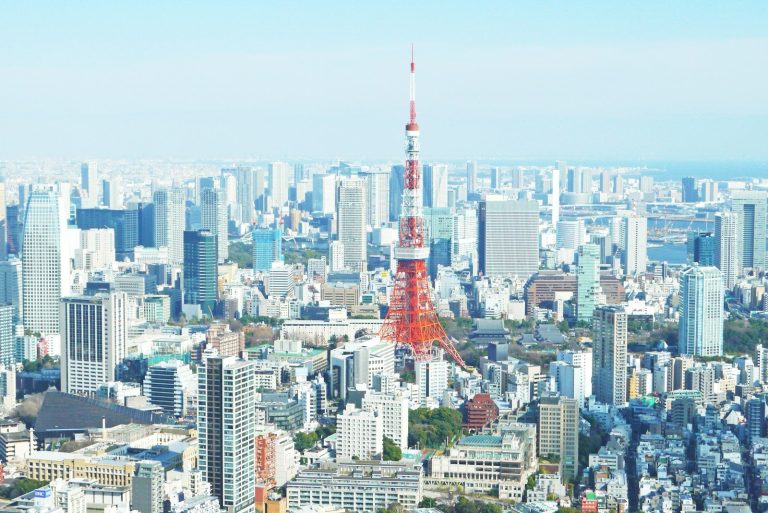
Three days is the right first bite of Tokyo, and in winter the city has one advantage the other two do not: it is the sunniest of the three every month from December to February. The days below are written to use that.
Day 1 — Asakusa, Ueno and the east side. Start at Senso-ji, and start early. The temple’s main hall opens at half past six from October to March, and by eight the approach is still quiet enough to photograph; by ten, it is one of the busiest places in the city. The temple grounds themselves never close, so the only clock you are working against is the main hall. From there, walk or ride one stop to Ueno, where the park’s museums and the market street below it can absorb the middle of the day. If it is wet or snowing: move the whole day indoors — Ueno’s museums are the obvious answer, and the covered arcades and department-store basements nearby are the fallback. Ueno is the simplest rain plan in Tokyo: the museum quarter and the station are effectively one complex.
Day 2 — Ginza, Marunouchi and the Imperial Palace. This is the most winter-shaped day on the Tokyo list, because Marunouchi’s illumination programme is the city’s most reliable lit evening of the season: the holiday campaign runs from 12 November to 25 December, and the Naka-dori street lights stay on through 14 February 2027. Come in the afternoon for the shopping streets and the palace-side walks, then stay for the lights once it is dark — which, in December, means not much after half past four. If you want the New Year’s shrine visit instead, swap this day for the first days of January and go to Meiji Jingu; note that the shrine opens with the sunrise and closes with it, which in December means a 16:00 close and in January 16:20, so an early start is not a suggestion.
Day 3 — Shibuya, Shinjuku and a night view. The west side works best on the shortest days, because its best hour is after dark. Use the daylight for the streets, the food halls and the department stores, then go up for a night view while it is still early enough to be worth it. If it is wet or snowing: this is the easiest day to convert, since the whole plan is already indoors and under cover — shopping streets, station complexes and observation decks.
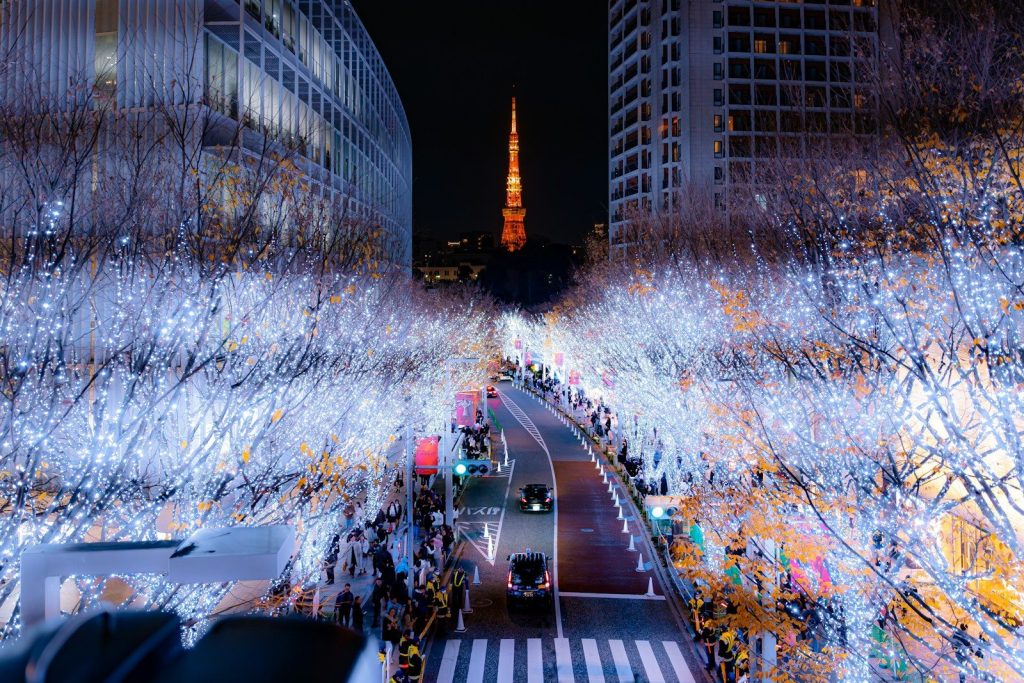
The evening block, and why it is the first thing to plan. In winter the dark arrives between 16:28 and 17:35 depending on the month, and that fact decides how a day is built. Rather than treating the early sunset as a loss, plan the day so that the last thing you do is the thing that needs the dark: illuminations in December, a night view, or a long dinner. And put the indoor, ticketed, weatherproof things in the slot after five, when the temples and gardens have closed anyway.
Hatsumode, if your dates are early January. The first shrine visit of the year is one of the great Japanese winter experiences, and also one of the most crowded. The first three days of January are the peak; Meiji Jingu and Asakusa’s Senso-ji are the busiest of all. If your trip begins in early January, go on a weekday morning rather than New Year’s Day itself, and expect the whole surrounding area to be full.
If you want Kyoto but only have one Tokyo day to give it. It is a long day, but it works: the shinkansen makes a Tokyo–Kyoto return possible if a guide handles both ends. Day-trip options with the transport and the walking arranged are listed here.
Day Trips from Tokyo
Tokyo sits at the centre of the most concentrated day-trip country in Japan, and winter changes which of them is worth the journey. The rule for all four below is the same: the cold, dry, clear air of January and February is what makes the distant views work, and the same air is what closes the mountain roads when it turns.
| Destination | Travel time | Best for | Winter note |
|---|---|---|---|
| Mount Fuji and the Fuji Five Lakes | A rail-and-bus run west of the city, comfortably a full day | The mountain itself — winter is when the air is clearest and the views most reliable | The view depends on cloud, not on temperature; go on a bright, dry day and accept that a February day can be clear in the morning and closed in by noon |
| Hakone | West of Tokyo, best treated as a long day or an overnight | Hot springs, lake views and the volcanic valley | Treat the mountain section as optional rather than fixed: the ropeway and the valley’s facilities should not be assumed to run normally in bad weather or during periods of high volcanic activity |
| Nikko | North of Tokyo, a full day | Shrines and temples in a mountain setting, and a lake beyond them | Beautiful in snow and genuinely cold; mountain roads and the higher routes are the first thing to be affected by winter weather |
| Jigokudani Snow Monkey Park | A long day from Tokyo, or a natural stop on a longer northern route | Wild monkeys bathing in a hot spring — the image most people have of a Japanese winter | Winter hours are 09:00 to 16:00 from November to March, visitors are asked to arrive at least thirty minutes before closing, there are no fixed closing days, admission fees are being revised from 1 December 2026, and ticketing has just changed: the park’s English page still says that no advance reservation service exists and that tickets are bought on the day, but the park’s own Japanese site now carries two separate items — a notice dated 6 August 2026 announcing that online ticket sales have begun, and a winter-season banner stating that from December to April entry is given priority to those who buy the web ticket — so if you are going in winter, buy online first |
Three things worth saying plainly about that list. The monkeys at Jigokudani are wild and bathe to keep warm; they are not always in the pool, at any hour, and a guide that guarantees the photograph is promising something nobody can deliver. The park has no closing days, which makes it one of the few winter attractions that is reliable on a holiday. And Hakone’s mountain section is the part of this list that can close on you: check the ropeway’s status before you set out, and keep a spare Tokyo day in reserve for it.
If the four above are what you would rather book than assemble — with the transport, the timing and the tickets handled — the day-trip and Snow Monkey options from Tokyo are collected below.
When to go north instead. Everything in this section is a day trip from a city that has little snow. If what you actually want is a white winter — deep snow, ice, and a landscape that matches the photographs — the answer is Hokkaido rather than a longer day trip: our Hokkaido in winter guide covers the drift ice, the northern national parks and the flights that get you there.
Kyoto in Winter, Day by Day
Kyoto is where winter pays you back. The city is the greyest and coldest of the three — it sits in a basin, and the cold settles into it — but it is also at its emptiest, and the big sites that are overwhelming in spring and unbearable in autumn are close to civilised in January. Four days lets you take it one direction at a time.
Day 1 — the east: Kiyomizu-dera, Higashiyama and Gion. Kyoto’s eastern temples open early, which is exactly what a short winter day needs. Work down from Kiyomizu-dera through the lanes of Sannenzaka and Ninenzaka towards Gion, and treat the walk itself as the attraction: the lanes are steep, stone-paved and quieter than the temple at their top. In Gion, keep to the public streets, do not follow or photograph geiko and maiko going about their work, and do not treat private alleys as a set. The neighbourhood is a residential district that tolerates visitors, and the small courtesies are what keep it that way — a guided walk is the simplest way to see it without getting that wrong.
Day 2 — the west: Arashiyama and the river. The bamboo grove and the riverside paths are open to anyone at any hour, and in winter they are markedly quieter. The Sagano Scenic Railway runs along the gorge above the river, and if you are travelling in early December, its illumination season — the “Fantasy Train of Light”, which by the last published schedule ran from 24 October to 29 December 2026 — is one of the few genuinely winter-specific things in the city. Note the date: it ends with the year, so a January trip does not get it.
Day 3 — the north: Kinkaku-ji, Ryoan-ji and Ninna-ji. This is the classic north-west circuit, and it belongs in the plan for one winter reason: these are the sites that appear under snow. Kinkaku-ji opens from 09:00 to 17:00, and the temples around it — Ryoan-ji with its stone garden, Ninna-ji with its halls — form a natural walking or short-taxi loop. A dusting on these roofs is the photograph people plan a winter trip around, and this is where to be when it happens.
Day 4 — the south: Fushimi and the sake district. Fushimi Inari’s grounds are open around the clock, so this is the day you can start before dawn if the light looks good, and the thousand gates are at their best in low winter light. Be aware that the shrine closes its precinct car park from 30 December to 6 January and that the first days of January are among the busiest of its year. Below the shrine, the Fushimi sake district is a working neighbourhood of canals, breweries and warehouses, and it makes an easy, flat, warm-stops afternoon to finish on.
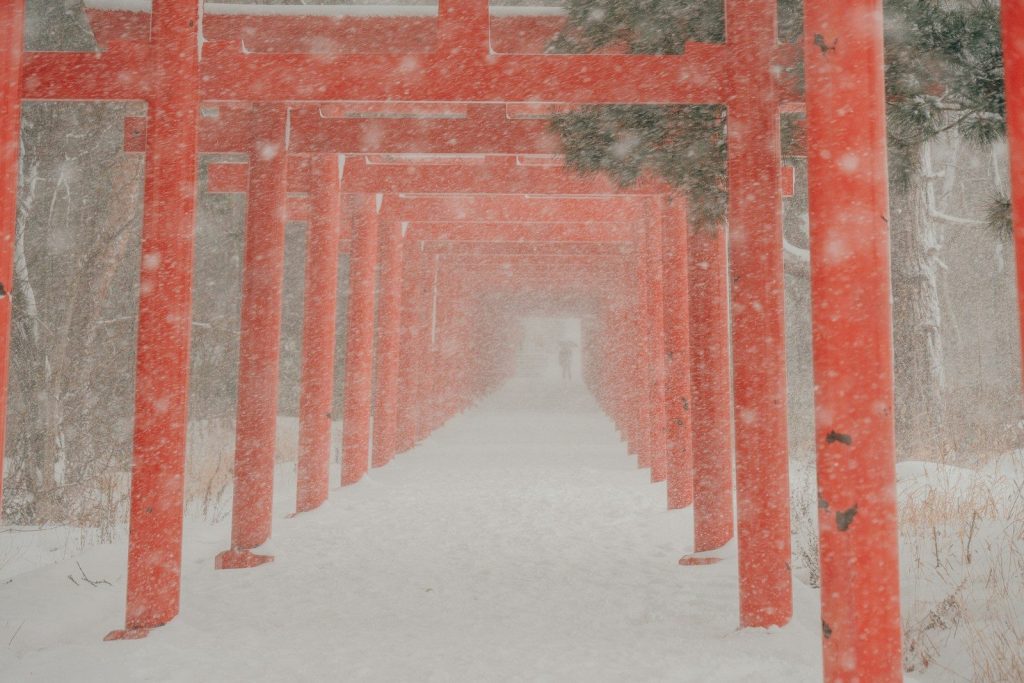
The Winter Openings programme. Each year Kyoto runs a limited-season programme in which cultural properties that are normally closed to visitors open to the public — the 2026 edition ran from 9 January to 18 March 2026, covering temples, shrines and buildings of cultural importance, with opening hours and periods that vary from one property to the next. It is the best-value thing in the city precisely because it is rare: several of the places that take part are not open at any other time of year. Because the 2027 edition has not been announced, check the city tourism association’s pages before you build a day around a specific property, and treat the pattern — roughly January to mid-March — as the planning assumption.
The snow-day plan. Kyoto snow is rare, which is what makes it worth reorganising a day for. If snow is falling or lying, do two things: go out early, because it is gone by the afternoon, and go to a temple with elevation and a garden rather than to a shopping street. The stone-and-moss gardens and the temple roofs read best under a thin cover, and the crowds that would normally be there are not. Do not, however, rearrange a long-distance move around it — snow is the one weather that can slow Kyoto’s buses and local trains, and a snow morning is best spent within one district.
Seeing Gion properly. A small-group walking tour is the most respectful and most efficient way to cover the district’s lanes, its history and its etiquette in an afternoon, and it is the option most travellers choose for this day. Walking tours of Gion and the geisha districts are listed here.
Osaka in Winter, Day by Day
Osaka is the least demanding of the three cities in winter and the easiest to like on a cold evening, because almost everything worth doing here is close together, indoors or under cover of food. It is also the mildest: the same months that put Kyoto at 4.8 °C in January put Osaka above six. Two or three days is plenty, and if you are based here for Kyoto as well, this section becomes your evening plan rather than your whole itinerary.
Day 1 — Dotonbori, Namba and the food streets. The canalside district is the postcard, and in winter it is at its best after dark, when the signs are lit and the cold makes the food counters look better than they are. Kuromon Market, the covered market street a few minutes away, is a daytime stop and a good rain plan. If it is wet: this entire day is effectively covered — the arcades, the market and the station complexes connect most of it.
Day 2 — Osaka Castle, the park and the east side. The castle’s main tower keeps generous hours compared with the temples — it opens at 09:00 and admits visitors until 17:30, closing at 18:00 — and the surrounding park is free and open at all hours, which makes it a flexible stop. Winter is the season when the castle’s stone walls and the surrounding moat are at their clearest, with the trees bare. From there, Shinsekai and its retro tower make a natural, slightly shabby, entirely Osaka second half of the day.
Day 3 — Umeda, and a long evening. The north side of the city is the shopping and dining half, with department stores, food halls and observation decks within a few minutes of each other. Use it as your last-day block, because it is the part of Osaka that is easiest to do with a suitcase nearby.
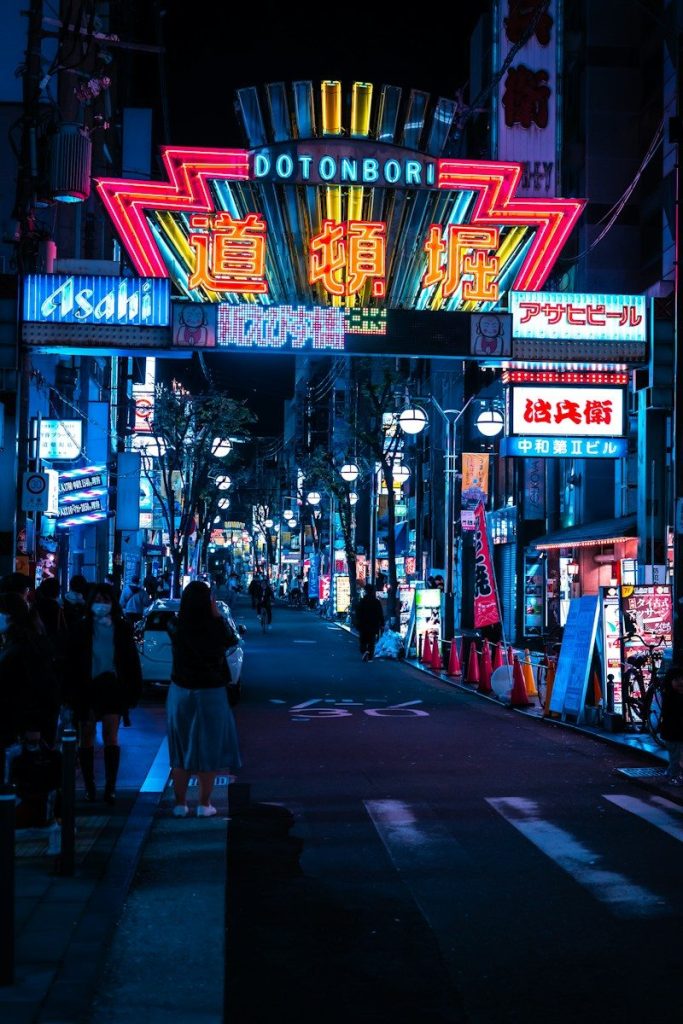
The Osaka winter calendar, in three notes. In December the city’s illuminations run at the main gathering points — the official city guide describes lit shop windows and building decorations against the dry winter sky. In the first days of January, the city’s shrines fill with the first visits of the year. And on 28 February 2027 the Osaka Marathon closes the main roads through the city centre for the day, which affects buses and taxis crossing the middle of the city; if your dates land on it, plan around the centre rather than across it.
Day Trips from Kyoto and Osaka
The two western cities share the same day-trip country, and all three of the trips below are short enough to be decided on the morning rather than booked in advance.
| Destination | Travel time | Best for | Winter note |
|---|---|---|---|
| Nara | Under an hour from Kyoto or Osaka by regional rail | The great Buddha hall at Todai-ji, the deer park, and a small city that feels older than either of its neighbours | Nara is colder than both Osaka and Kyoto, and the city’s own tourism association describes mid-January to early February as the coldest stretch of its year; the Shuni-e ceremony at Todai-ji, which marks the arrival of spring here, falls in March, so a winter visit catches the city in its quiet season |
| Kobe | A short run west of Osaka | A harbour city with a compact centre, a mountain backdrop and a distinctly different feel from Osaka | Small, walkable and mild; the mountain ropeway and the hillside district are the parts to check before committing on a windy day |
| Uji | A short run south of Kyoto | Tea country: the riverside town where Japanese green tea is most associated, and the temple that appears on the ten-yen coin | Small and slow, and best as a half-day; the riverside walk is pleasant in cold, dry weather and bleak in rain |
Nara deserves the extra note, because it is the day trip that most repays a winter visit and the one most often cut. The deer park and the temple grounds are open in the way parks are open, the crowds of spring and autumn are absent, and the cold is the price. Go early, when the frost is still on the park, and take the first trains rather than the most convenient ones.
Day trips to Nara and the surrounding area, with transport and guiding included, are listed here.
What Winter Actually Changes
Read the section titles above again and a pattern appears: nearly every adjustment in this guide comes from one of five things. This is the summary version, and if you remember nothing else, remember this table.
| What winter changes | What it means in practice | What to do about it |
|---|---|---|
| The light goes between 16:28 and 17:35 | Your usable outdoor day is roughly 08:00 to 16:30, with the last half hour already in low light | Front-load the day: temples and gardens in the morning, indoor and lit things after dark |
| Many small places shut from 29 December to about 4 January | A handful of the specific places you came for may be closed for the exact days you are there | Check the individual site’s own page for its New Year closure before you build a day around it |
| Snow is rare in the cities, but disruptive when it comes | The shinkansen usually runs; local lines, mountain buses and expressways slow down | Never put a city-to-city move on your departure day; give mountain days a spare day |
| Everything goes dark after 25 December | The holiday campaigns end then, but Marunouchi’s Naka-dori street lights run from 12 November 2026 to 14 February 2027, and the city’s other lit streets keep their own schedules | If lights matter, either the first three weeks of December or the first half of February works; late December is the crowded version of the first option |
| Peak travel concentrates into a few days | 1–3 January, the January long weekend and 11 February are the pinch points for seats and rooms | Book those legs as soon as your dates are fixed, and treat a reserved seat as necessary on those days |
Two further things are worth adding because they are easy to miss. The first is that winter is the best season of the year for an onsen evening: the cold is what makes the hot water feel like a reward, and in Kyoto and Osaka there are baths within walking distance of the central districts. The second is that the short day compresses everything — three temples that would be a comfortable spring day become a rushed winter one, so cut one rather than run between them.
If the result of that table is that you would rather trade the cities for a genuinely snowy winter, the two guides that cover it are our Japan in winter guide for the country as a whole and the Sapporo Snow Festival 2027 for the one week in February when the festival runs in a city that has real snow.
Packing for a Cold City Walk
The clothing question on this route is not “how cold is it” — it is “how long am I standing outside”. A Tokyo January averages 5.4 °C and a Kyoto January 4.8 °C, which is mild by northern standards, but you will be outside for hours at a time, in the dark, often standing still, and that is a different problem from a cold commute.
The answer is layers, in three parts. A base layer that moves moisture away from your skin, a mid layer that holds warmth — a fleece or a light down jacket — and an outer layer that stops wind and rain. Add or remove the middle layer as the day changes, which is exactly why a single heavy coat is the wrong purchase for this trip: it is either too much at eleven in the morning or not enough at five in the afternoon.
Beyond that, five things earn their place in the bag. Footwear with grip matters more than insulation, because temple steps, stone lanes and station floors are what you will actually be walking on; a thin, hard-soled shoe is the one item that can ruin a day. Gloves and a hat are the two items people leave at home and then buy badly on the first morning. A compact rain shell beats an umbrella for city walking, partly because wind makes umbrellas useless and partly because you will want your hands free. A power bank is not optional in winter — phone batteries discharge noticeably faster in the cold, and your phone is your map, your ticket and your camera. And a scarf or neck gaiter does more for perceived warmth than any additional layer on your torso.
What you do not need: a large umbrella, a new pair of shoes that has not been broken in, or a suitcase full of outfit changes. This is a walking trip in a country with excellent laundries, and one warm layer worn every day is worth more than three that you rotate.
One small extra that is genuinely worth packing: hand warmers. The disposable kind are sold everywhere here in winter, they cost very little, and they turn a cold half hour at a temple gate into a comfortable one.
What to Book Early (and When)
Most of this trip can be booked a few weeks out. A minor share of it cannot, and the distinction is what this section is for — because the things that sell out here sell out to the domestic market first, long before an international visitor starts looking.
| What | How early it is safe | Why it goes first |
|---|---|---|
| Shinkansen reserved seats on peak days | As soon as your dates are fixed | 1–3 January, the January long weekend and 11 February are days when the whole country is moving; on other days you can simply turn up |
| Kyoto accommodation in the first half of January and around 9–11 January | Months ahead, or accept a worse location | Kyoto has fewer rooms than Tokyo or Osaka and the winter openings programme brings visitors in specifically for it |
| Hotels in any of the three cities for 1–3 January | Months ahead | This is the domestic New Year holiday: the single most booked short window of the Japanese year |
| Small-group experiences — walking tours, guided day trips, cooking and craft sessions | Weeks ahead | Capacity is the product; a group of eight that is full is simply full, and winter is when the good ones fill with visitors escaping the cold |
| Specific restaurants | Weeks ahead, and often through your hotel | A handful of places take bookings only through concierges, and this is the one category where asking your hotel is the practical answer |
| Anything in the mountains — Hakone, Nikko, the Fuji area | Weeks ahead in the peak window | Winter services are reduced, and Hakone’s mountain section is best treated as the optional part of that day: check whether the ropeway is running before you commit, and keep a spare Tokyo day in reserve |
The pattern behind that table is worth internalising: anything with a fixed capacity and a winter-specific reason to be popular needs booking, and everything with a rolling capacity does not. Shinkansen seats are the clearest example — on an ordinary Tuesday you arrive and sit down, and on 2 January you do not.
Two bookings deserve a mention because they are the ones travellers regret. The first is the Kyoto hotel. If your dates include the first ten days of January, book the room before you book anything else, and be prepared to accept a location slightly outside the centre: a twenty-minute bus ride into Higashiyama is a far better outcome than a week in a city with no room. The second is the small guided experience. Winter is the season when the walking tours, the temple-and-garden sessions and the food-and-sake evenings in Kyoto and Osaka are at their most comfortable — no crowds, no heat — and the good ones run with a handful of people at a time.
If you would rather have the winter-specific experiences assembled for you — the food, the craft, the guided walks, the sake district — the Kyoto and Osaka options are collected below.
And if the whole trip is better handled as a package, with the cities, the transport between them and the winter timing already arranged, multi-day Japan winter itineraries are listed here.
FAQ: Japan Winter Itinerary Questions
Which city order makes the most sense on a Japan winter itinerary?
Tokyo first, then Kyoto, then Osaka — and fly home from Osaka’s airport rather than doubling back. The reason is not scenery but logistics: Tokyo has the two busiest arrival airports and the widest choice of flights, Osaka’s Kansai airport is the natural exit from the western end, and the shinkansen runs in a straight line between them. If your flights force the reverse, the trip works equally well in that direction, with one caveat — do not put the longest rail leg on the day you fly home, because a snow-delayed morning is the one thing that can cost you a flight.
What is the minimum number of days?
Seven nights, split two in Tokyo, three in Kyoto and two in Osaka, and that is genuinely tight: each change of city costs you roughly half a day, and in winter the usable daylight ends by half past four. If you would rather not assemble the transport and the timing yourself, the multi-day version of this route is listed here. Ten nights is the comfortable version, and gives you one day trip from Tokyo and one from Kyoto. Below seven days, drop a city rather than compress three.
Will it snow, and when?
Probably not, and that is the honest answer. The Japan Meteorological Agency’s 1991–2020 normals put the deepest snow normally lying in an entire winter month at three centimetres in Tokyo, four in Kyoto and one in Osaka, with no measurable depth recorded in December in any of the three. Snow here is a short event, most likely in January and February, and worth reorganising a day around when it arrives — but not something to book a trip around. If a white winter is the point, go north: the Sapporo Snow Festival 2027 runs from 4 to 11 February in a city where snow lies all winter.
Does everything stay open in late December?
No, and this is the most common planning error on this route. Many museums, gardens and small food counters close from 29 December and reopen around 4 January, and some cultural properties in Kyoto stay shut through January. The large temples and shrines remain open — they are busiest at exactly that time — so build the New Year days around outdoor sites and department-store food halls, and check each individual site’s own page for its closure dates.
Do you need to book shinkansen seats in advance?
On most days, no: the Tokaido Shinkansen runs several times an hour and carries both non-reserved and reserved cars, so you can turn up and travel. The exceptions are 1 to 3 January, the January long weekend and 11 February, when the country is travelling at the same time you are and a reserved seat stops being a convenience. In those windows, book as soon as your dates are fixed.
What should you wear and bring?
Three layers — a moisture-wicking base, a warm middle and a wind-and-rain outer — plus shoes with real grip, gloves, a hat and a scarf. The outer layer matters more than the heaviest possible coat, because you will be adding and removing it through a day that runs from a cold morning to a dark, colder afternoon. Add a power bank, since phone batteries drain faster in the cold, and hand warmers, which are cheap and sold everywhere here in winter. Leave the big umbrella and the unworn new shoes at home.
Japan Winter Itinerary: The Decisions, in Order
Strip the detail away and this Japan winter itinerary asks you to make five decisions, in this order. First, which month: December for illuminations and the sunniest walking, January for the emptiest temples and the clearest skies, February for the best chance of snow on a roof and the start of plum blossom. Second, how long: seven, ten or fourteen nights, with ten as the version that fits without rushing. Third, which direction: Tokyo to Osaka, unless your flights say otherwise. Fourth, what to book before anything else: the Kyoto room if your dates touch early January, and the shinkansen seats if they touch a peak day. Fifth, how to spend each day: outdoors and moving until the light goes, indoors and lit afterwards.
Get those five right and the trip needs very little managing. The route itself is straightforward, the trains run frequently, and the winter that most travellers fear — cold, dark, closed — turns out to be the season when the temples are quiet, the air is clear and the cities are yours.
Every figure in this guide comes from an official source, accessed on 8 October 2026: climate normals from the Japan Meteorological Agency, sunrise and sunset from the national astronomical observatory, public holidays from the Cabinet Office, and hours, closures and programme windows from the sites and tourism associations that run them. Verify the details that matter to you before you travel — the pattern holds, but the dates of any single year’s programme are set by the people who run it.
If you would rather travel this route with the arrangements made for you — hotels, the shinkansen legs between the cities, and the day trips — the bookable version of this Japan winter itinerary, covering Tokyo, Kyoto, Osaka and Nara, is listed here.